
Blog Details
Diskava. Beta. Kava
09Sep
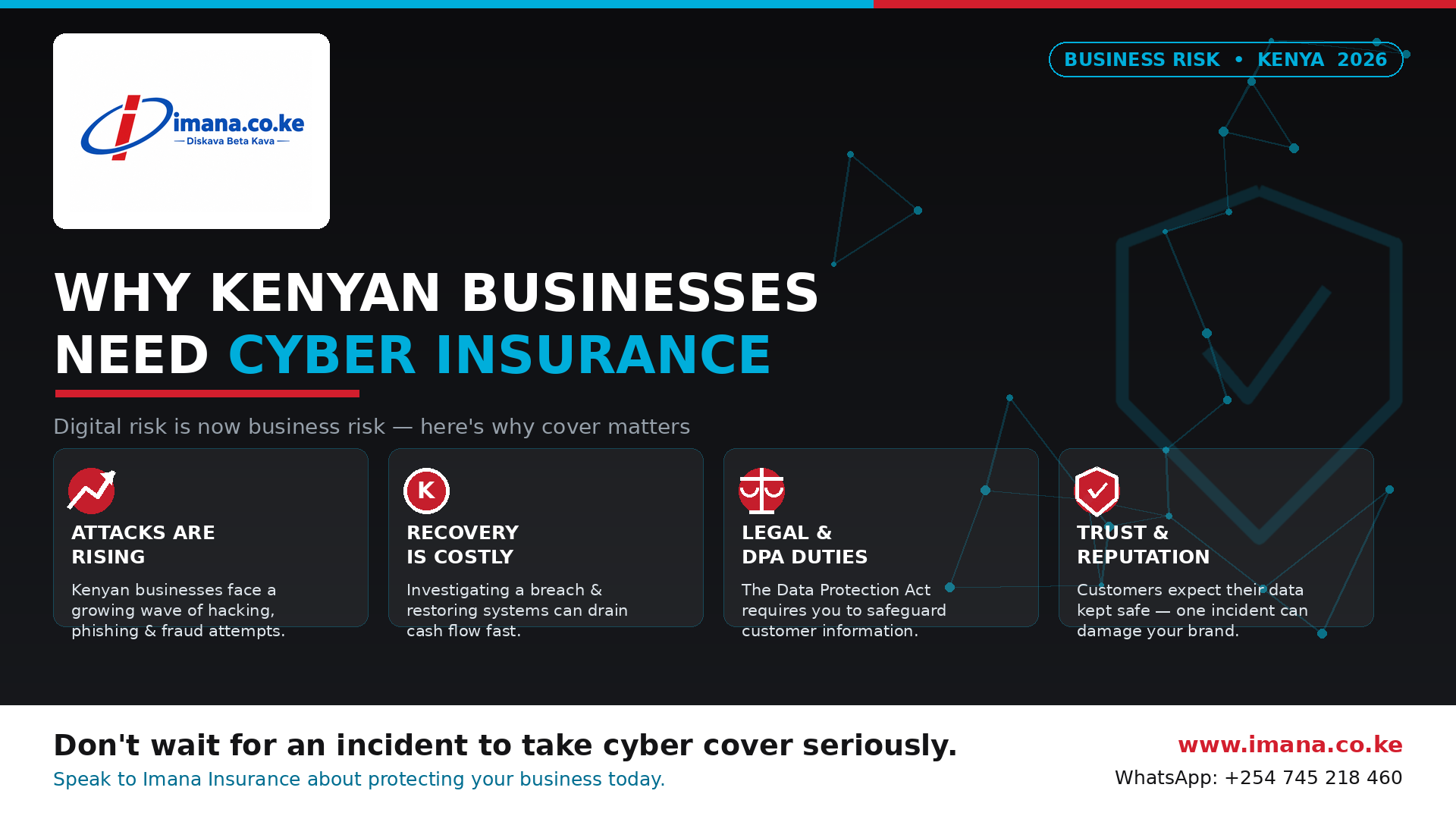
Why Kenyan Businesses Need Cyber Insurance
Discover why Kenyan businesses need cyber insurance for ransomware, data breaches, digital fraud, business interruption and privacy liability.
A locked office can keep a burglar away from physical files. It cannot stop a criminal on another continent from entering the business through an employee’s email.
Kenyan businesses are moving fast into cloud storage, mobile money, online banking, digital customer records, remote work and automated platforms. That digital growth creates opportunity—but it also creates new doors through which money, data and business continuity can disappear.
Cyber insurance helps an organisation manage specified financial losses and response expenses after cyber defences fail.
Quick answer: Kenyan businesses need cyber insurance because a data breach, ransomware attack, fraudulent transfer or system outage can generate restoration costs, lost income, legal liability and regulatory obligations that ordinary business insurance may not cover.
Cyber insurance does not prevent an attack. It gives the business access to funding, specialists and a defined recovery process when an insured cyber incident occurs.
For a complete explanation of the policy, read Cyber Insurance in Kenya: Data Breaches, Ransomware and Business Interruption.
Cyber risk in Kenya is no longer theoretical
Kenya’s growing digital economy has expanded the number of devices, transactions, systems and organisations exposed to cyber threats.
The Communications Authority reported more than 4.5 billion detected cyber-threat events between October and December 2025, representing a significant increase from the preceding quarter. The Authority connected this surge to issues including poor system patching, low awareness of phishing and social engineering, and the misuse of artificial intelligence by cybercriminals.
During January to March 2026, approximately 3.4 billion cyber-threat events were detected. Although this was lower than the preceding quarter, it still represented an enormous volume of hostile or suspicious digital activity.
Not every detected threat becomes a successful attack. But the scale shows why “we are too small to be targeted” is no longer a sensible risk-management position.
Small businesses are not too small for cybercriminals
Many SMEs assume criminals are interested only in banks, government systems and multinational companies.
In reality, a small business may be attractive because it can have:
- Weak passwords
- Limited IT support
- Untested backups
- Shared user accounts
- No multi-factor authentication
- Poor payment-verification procedures
- Employees who have not received cybersecurity training
- Outdated software
- No incident-response plan
An attacker does not need to know the business personally. Automated tools can search the internet continuously for vulnerable systems, exposed passwords and unpatched software.
A small organisation can suffer a devastating loss even where the amount would appear minor to a large corporate.
A cyberattack can stop the entire business
Modern organisations depend on systems to:
- Communicate with customers
- Receive orders
- Process payments
- Access customer records
- Deliver professional services
- Manage stock
- Issue invoices
- Pay suppliers
- Coordinate employees
- Operate websites and applications
- Maintain regulatory records
When those systems become unavailable, the business can lose income every hour.
Employees may still require salaries. Rent remains payable. Customers still expect delivery. Suppliers still request payment. Meanwhile, the business may have to pay forensic experts, lawyers and data-recovery professionals.
This is why cyber risk is not merely an IT issue. It is a business-survival issue.
Reason one: ransomware can lock the business out
Ransomware can encrypt files, block access to systems or threaten to publish stolen information.
The attacker may demand payment in exchange for a decryption key or promise not to release the data.
Even if no ransom is paid, the business may incur costs for:
- Emergency forensic investigation
- Malware removal
- Legal advice
- System rebuilding
- Data restoration
- Replacement hardware
- Overtime
- Customer communication
- Public-relations support
- Lost income
Payment does not guarantee that data will be restored or deleted.
A cyber policy may provide access to approved specialists who can help contain the incident, investigate what happened and guide recovery.
Ransomware protection remains subject to policy conditions, exclusions, limits and applicable law.
Reason two: data breaches create legal responsibilities
Kenyan organisations collect personal information from customers, patients, employees, students, members and suppliers.
This may include:
- Names and telephone numbers
- National identification details
- Email addresses
- Bank information
- Medical records
- Payroll information
- Student records
- Loan details
- Login credentials
- Photographs
- Biometric information
When this information is lost, exposed or accessed without authority, the incident may create legal and regulatory obligations.
Kenya’s Data Protection Act requires qualifying personal-data breaches to be reported to the Data Commissioner without delay and within 72 hours of the data controller becoming aware of the breach. Data processors have related notification duties to data controllers.
The business may need to determine:
- What happened
- Which systems were affected
- What information was exposed
- How many people were affected
- Whether serious harm is likely
- Whether affected individuals must be informed
- What immediate safeguards are required
- Whether another regulator or law-enforcement agency must be notified
Cyber insurance may provide access to forensic and legal professionals who can help manage this process.
Insurance does not remove the organisation’s legal responsibilities. It can help finance and coordinate the response.
Reason three: one fraudulent email can redirect millions
Cybercriminals use social engineering to manipulate employees into:
- Changing supplier bank details
- Sending money to a false account
- Revealing passwords
- Opening malicious attachments
- Approving fake invoices
- Sharing confidential information
A fraudulent message can appear to come from:
- The CEO
- A supplier
- A bank
- An auditor
- A customer
- An IT provider
- A government authority
- A fellow employee
Criminals may first compromise a genuine email account and study previous conversations. When the fraudulent payment request finally arrives, it can look completely normal.
Standard cyber insurance does not always cover money voluntarily transferred after deception. The business may need specific social-engineering, computer-crime or funds-transfer protection.
This extension deserves close attention during quotation comparison.
Reason four: ordinary insurance may not cover cyber losses
Businesses often assume an existing insurance policy will respond.
However:
- Fire insurance protects against specified physical damage
- Burglary insurance addresses particular theft circumstances
- Electronic Equipment Insurance generally focuses on physical equipment risks
- Fidelity Guarantee covers defined employee dishonesty
- Professional Indemnity addresses claims arising from professional services
- Business Interruption traditionally follows insured physical damage
- Public Liability ordinarily concerns bodily injury or property damage
These policies do not automatically cover ransomware, privacy breaches, digital forensics, cybercrime or network interruption.
Cyber insurance addresses a different category of loss.
The policies can complement one another, but the business should identify possible overlaps and gaps before an incident occurs.
Reason five: data restoration is expensive
Data recovery involves more than switching a computer off and on.
After an attack, specialists may need to:
- Identify the entry point
- Determine whether attackers remain inside
- Remove malicious software
- Inspect backups
- Reinstall applications
- Rebuild servers
- Reset credentials
- Restore data
- Test system security
- Monitor for further intrusion
A business with no tested backup may have to reconstruct records manually—or may never recover them.
Cyber insurance can cover eligible restoration and system-recovery costs, subject to the policy.
The policy will not normally improve obsolete systems beyond their previous condition unless the wording provides otherwise.
Reason six: downtime can cost more than the damaged system
The most visible expense after a cyberattack may be the IT invoice. The bigger loss may be the income the business could not earn.
Consider:
- A hotel unable to receive online bookings
- A SACCO unable to serve members
- A law firm locked out of client documents
- A school unable to access student systems
- A clinic unable to retrieve patient information
- A logistics company unable to track deliveries
- An online shop unable to process orders
- A manufacturer whose network-dependent production stops
Cyber business-interruption insurance may cover eligible loss of income and additional expenses during a covered outage.
The policy may contain a waiting period and an indemnity period. These determine when cover begins and how long eligible interruption losses can be claimed.
Reason seven: outsourced technology does not outsource responsibility
Kenyan businesses increasingly depend on third-party providers for:
- Cloud hosting
- Online payments
- Accounting software
- Customer relationship management
- Website hosting
- Payroll systems
- Booking platforms
- Core banking
- Medical administration
- Data storage
When an external provider suffers a cyber incident, the organisation may still lose access to essential services.
The supplier may not reimburse every resulting loss. Its contract may significantly limit liability.
Cyber insurance can sometimes be extended to dependent business interruption caused by a covered event affecting a technology provider.
Do not assume this extension is included automatically.
Reason eight: customers expect their information to be protected
A data breach can damage trust long after systems are restored.
Customers may ask:
- Why was the information collected?
- How was it protected?
- How did the breach happen?
- Why were they not informed sooner?
- What steps should they take?
- Can the information be used for fraud?
- What is the business doing to prevent another breach?
A careless, delayed or inaccurate response can deepen the reputational damage.
Cyber insurance may provide crisis-communication and notification support. The business still needs honest leadership and a credible recovery plan.
Insurance cannot purchase trust instantly, but it can help the organisation respond professionally.
Reason nine: employees make mistakes
Not every cyber incident begins with a sophisticated hacker.
An employee may:
- Send information to the wrong recipient
- Lose an unencrypted laptop
- Use a weak password
- Click a phishing link
- Share login credentials
- Upload confidential information to an unsafe platform
- Approve a fraudulent payment
- Leave a former employee’s account active
- Misconfigure a cloud folder
Some cyber policies cover specified incidents arising from accidental employee actions.
Intentional, fraudulent or reckless conduct may be excluded or handled differently.
Training remains essential because technology cannot prevent every human error.
Reason ten: incident-response experts are expensive and urgently needed
During a serious cyber incident, the business may need several specialists at once:
- Digital-forensics investigators
- Cybersecurity consultants
- Privacy lawyers
- Ransomware specialists
- Data-restoration professionals
- Crisis-communication advisers
- Customer-notification providers
Without pre-arranged support, management may waste critical hours searching for providers and negotiating fees.
A well-structured cyber policy can provide an emergency-response hotline and approved specialists.
This response network can be just as important as the financial limit.
Which Kenyan businesses should consider cyber insurance?
Any organisation that depends on technology, handles confidential information or processes digital payments should assess its cyber exposure.
Priority sectors include:
SACCOs and financial institutions
SACCOs hold identity, transaction, loan and member information. They can face fraudulent transfers, ransomware, privacy claims and platform interruption.
Hospitals and healthcare providers
Hospitals, laboratories and clinics depend on patient, billing and treatment systems while handling highly sensitive health information.
Law firms
Law firms store confidential client documents, transaction information and payment instructions. Email compromise can create both cyber and professional liability exposure.
Schools and universities
Educational institutions hold information relating to children, parents, employees, examinations, payments and medical needs.
Hotels and travel businesses
These organisations process guest identities, passports, payment information, booking details and travel records while depending heavily on external platforms.
Retail and e-commerce businesses
Online sales create exposure through payment systems, customer databases, websites and fulfilment platforms.
Logistics and manufacturing businesses
A cyberattack can interrupt tracking, warehousing, deliveries, production and supplier communication.
Professional firms
Accountants, architects, engineers, consultants and other advisers hold confidential client information and rely on email and cloud systems.
SMEs
Small businesses may have fewer resources to absorb recovery costs, making one serious incident disproportionately damaging.
Is cybersecurity enough without insurance?
No single control is enough.
Firewalls, antivirus software, secure backups and employee training can reduce risk. They cannot eliminate:
- Human error
- New software vulnerabilities
- Supply-chain attacks
- Insider threats
- Sophisticated phishing
- Cloud-provider incidents
- Zero-day attacks
- Ransomware
Cybersecurity reduces the probability and severity of an incident. Insurance addresses specified financial consequences after one occurs.
The two should operate together.
Is cyber insurance enough without cybersecurity?
No.
Insurers may require:
- Multi-factor authentication
- Endpoint protection
- Secure backups
- Regular security updates
- Restricted administrator access
- Employee awareness training
- Payment-verification controls
- An incident-response plan
Weak controls may result in higher premiums, restrictive terms or a declined quotation.
Incorrectly claiming that a security measure is in place can also create serious problems during a claim.
Cyber insurance is not a permission slip for weak security.
How much does cyber insurance cost in Kenya?
Cyber insurance premiums depend on:
- Annual turnover
- Industry
- Number of employees
- Type and volume of data
- Required limit
- Policy excess
- Online revenue
- Cybersecurity controls
- Previous incidents
- Business-interruption exposure
- Cybercrime requirements
- Countries of operation
Small organisations with lower exposure may pay less than hospitals, SACCOs, fintech companies or businesses holding large volumes of personal information.
Read the Cyber Insurance Cost Guide Kenya for pricing factors and planning estimates.
A proper quotation requires underwriting information. There is no responsible universal price for every business.
What should cyber insurance cover?
Depending on the organisation’s risks, consider:
- Incident response
- Digital forensics
- Data restoration
- System recovery
- Ransomware response
- Cyber extortion
- Cyber business interruption
- Dependent business interruption
- Privacy liability
- Network-security liability
- Regulatory investigations
- Crisis communication
- Customer notification
- Social-engineering fraud
- Funds-transfer fraud
- Media liability
Not every quotation will include all these sections.
Cybercrime and social engineering deserve special attention because many policies cover response costs without automatically covering money transferred to a fraudster.
How much cyber cover does a business need?
A business should estimate the cost of a credible major incident.
Consider:
- Cost of forensic specialists
- Cost of system restoration
- Lost income during downtime
- Additional operating expenses
- Number of people who may need notification
- Legal and regulatory costs
- Potential third-party claims
- Value of possible fraudulent transfers
- Dependence on external providers
- Crisis-communication expenses
The chosen limit should reflect the organisation’s exposure—not merely the lowest available premium.
What information is needed for a quotation?
Prepare:
- Company name
- Business activities
- Website
- Annual turnover
- Number of employees
- Countries of operation
- Type and volume of personal data
- Critical systems
- Online payment activities
- Technology providers
- Backup arrangements
- Cybersecurity controls
- Previous incidents and claims
- Required insurance limit
- Completed proposal form
More complex organisations may need a technical risk assessment before final terms are offered.
Frequently asked questions
Is cyber insurance mandatory in Kenya?
Cyber insurance is not generally compulsory for every business. Organisations must still comply with applicable privacy, cybersecurity and sector regulations.
Is cyber insurance only for technology companies?
No. Any business using email, online banking, customer data, mobile money, cloud storage or digital systems can suffer cyber loss.
Does cyber insurance cover ransomware?
It may cover eligible incident response, restoration, interruption and extortion expenses, subject to the wording and applicable law.
Does cyber insurance cover M-Pesa or bank-transfer fraud?
Not automatically. Social-engineering, computer-crime or funds-transfer extensions may be required.
Can an SME obtain cyber insurance?
Yes, provided it satisfies the insurer’s underwriting and minimum-security requirements.
Does cyber insurance cover a data breach caused by an employee?
Some policies cover accidental employee errors. Intentional or dishonest conduct may be excluded or handled under another policy.
Does cyber insurance cover cloud-service failure?
Only where the appropriate dependent-system or technology-provider extension is included.
Will the insurer pay every regulatory fine?
No. Fines are covered only where legally insurable and expressly included. Regulatory defence costs may be treated separately.
Can cyber insurance restore customer trust?
Insurance can fund professional response and communication, but rebuilding trust still requires transparency, accountability and improved security.
How quickly should an incident be reported?
Notify the insurer immediately. Qualifying personal-data breaches may also require notification to the Data Commissioner within the statutory period.
Five questions every business leader should ask
Before deciding that cyber insurance is unnecessary, ask:
- How long can the business operate without its systems?
- How much would one week of downtime cost?
- What personal or confidential information is stored?
- How much money can one employee transfer?
- Who would management call at midnight after a ransomware attack?
If the answers are unclear, the organisation has more cyber exposure than it understands.
Compare cyber insurance quotations in Kenya
Imana Insurance Agency Kenya Ltd helps Kenyan businesses evaluate their cyber risks, prepare underwriting information and compare quotations from licensed insurers.
Start by reading the Cyber Insurance Authority Guide and Cyber Insurance Cost Guide.
For a quotation:
- Visit ImanaInsurance.com for guided insurance comparison
- Submit the Corporate Insurance Quotation Form
- Visit Imana.co.ke for insurance authority resources
- Explore MyKava.co.ke for travel, medical and digital insurance comparison
Contact Imana Insurance Agency Kenya Ltd
Imana Insurance Agency Kenya Ltd
4th Floor, Krishna Centre
Woodvale Grove, Westlands, Nairobi
Call/WhatsApp: +254 796 209 402
Websites:
- www.imanainsurance.com — quotation comparison and enquiries
- www.imana.co.ke — Kenyan insurance authority and product information
- www.mykava.co.ke — travel, medical and insurance comparison
Imana Insurance Agency Kenya Ltd is a Westlands-based insurance intermediary helping individuals, families and businesses compare insurance quotations from licensed Kenyan insurers across Motor, Medical, WIBA, PSV, Travel, Motorcycle, Cyber, SME/Corporate and other insurance classes.
Author: Raymond Momanyi
Founder & CEO, Imana Insurance Agency Kenya Ltd
Disclaimer: This article provides general information. Cyber insurance cover, limits, exclusions, security conditions and claim requirements vary by insurer and policy. Review the proposal form, quotation, policy schedule, endorsements and full wording before purchasing cover.