
Blog Details
Diskava. Beta. Kava
09Sep
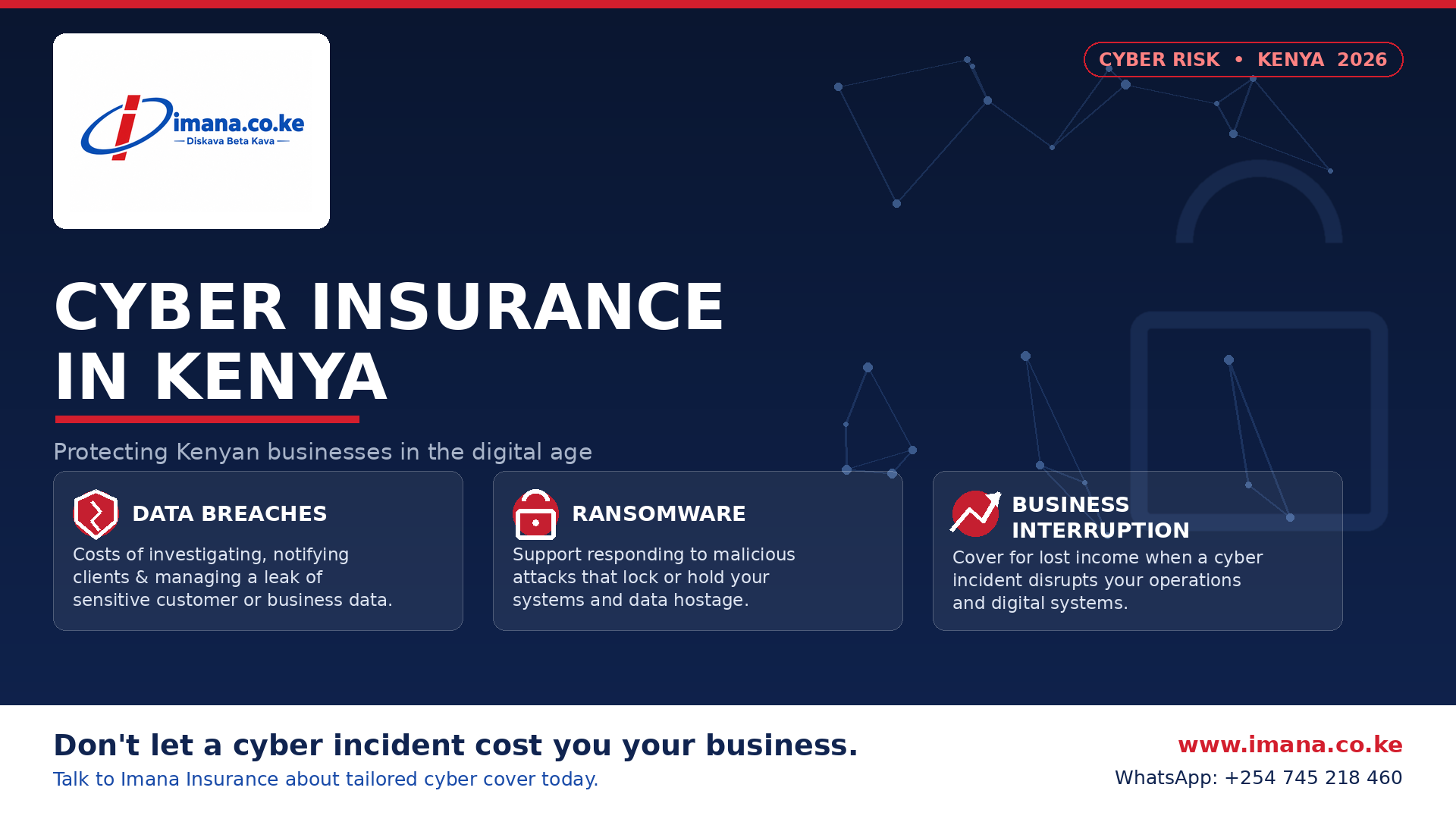
Cyber Insurance Kenya: Data Breach & Ransomware Cover
Understand cyber insurance in Kenya, including ransomware, data restoration, privacy liability, business interruption and incident-response cover.
Cyber Insurance in Kenya: Data Breaches, Ransomware and Business Interruption
A cyberattack does not need to destroy a building to stop a business.
One compromised email account can redirect supplier payments. One ransomware infection can lock an entire organisation out of its systems. One stolen laptop can expose customer, patient, student or member information. One technology outage can suspend operations for days.
Fire insurance protects physical buildings and equipment. Fidelity Guarantee may address certain employee dishonesty. Electronic Equipment Insurance may cover physical damage to computer hardware. None of these automatically provides the full financial and specialist response required after a cyber incident.
That is the gap cyber insurance is designed to address.
Quick answer: Cyber insurance helps an organisation manage eligible financial losses, recovery expenses and third-party liabilities arising from events such as data breaches, ransomware, system interruption, cybercrime and privacy claims. The precise protection depends on the policy wording, limits, sublimits, exclusions and security controls declared during underwriting.
Imana Insurance Agency Kenya Ltd helps Kenyan businesses compare cyber insurance quotations from licensed insurers and evaluate whether the proposed cover matches their technology, data and operational risks.
For a cyber-risk assessment and quotation, visit ImanaInsurance.com or submit a corporate insurance quotation request.
What is cyber insurance?
Cyber insurance is a specialised business insurance policy designed to respond to specified digital incidents and their financial consequences.
Depending on the policy, it may provide:
- Incident-response specialists
- Digital-forensics expenses
- Data and system restoration
- Cyber business interruption
- Privacy-breach response
- Legal advice
- Public-relations support
- Defence against third-party claims
- Regulatory investigation costs
- Cyber extortion response
- Social-engineering or funds-transfer protection
- Notification and communication expenses
Cyber policies are not identical. Two quotations carrying the same limit may contain very different definitions, sublimits, waiting periods and security requirements.
The strongest comparison therefore examines what the policy will actually do during an incident—not merely its annual premium.
Why do Kenyan businesses need cyber insurance?
Kenyan organisations increasingly depend on:
- Cloud storage
- Online banking
- Mobile money
- Customer databases
- Hospital and school systems
- Accounting software
- E-commerce
- Remote access
- Digital payment platforms
- Third-party technology providers
- Online booking and service portals
That convenience also creates concentration risk.
If access to a critical system disappears, business can stop. If personal information is exposed, the organisation may face legal, regulatory and reputational consequences. If an employee follows a fraudulent payment instruction, the money may disappear within minutes.
Strong cybersecurity can reduce the probability and impact of an attack, but no technical control eliminates every risk. Cyber insurance supplies a financial and specialist-response layer after preventive controls fail.
It should support cybersecurity—not replace it.
What is first-party cyber cover?
First-party cover protects the insured organisation against eligible losses it suffers directly.
Depending on the wording, these may include:
- Digital-forensics expenses
- Data restoration
- System recovery
- Business-interruption losses
- Additional operating expenses
- Cyber-extortion response
- Crisis communication
- Customer notification
- Credit-monitoring services
- Legal and regulatory advice
- Certain cybercrime losses
The policy may appoint approved response providers immediately after notification. Using an unauthorised vendor without the insurer’s approval can affect recovery of those costs.
What is third-party cyber liability?
Third-party liability cover addresses certain claims made against the insured organisation by customers, patients, members, employees, suppliers or other parties affected by a cyber or privacy incident.
It may include eligible:
- Legal defence costs
- Privacy liability
- Network-security liability
- Media liability
- Settlements or damages
- Regulatory investigation costs
- Contractual notification expenses where covered
The policy will usually specify whether defence costs sit within or outside the overall limit.
Cyber liability should not be confused with Professional Indemnity, Public Liability, Fidelity Guarantee or Directors and Officers Liability. These policies address different risks, although some incidents can potentially involve more than one cover.
Does cyber insurance cover ransomware?
Cyber insurance may cover certain consequences of ransomware, subject to the policy.
Ransomware is malicious software or unauthorised activity that encrypts systems, blocks access to data or threatens to release information unless a demand is met.
Possible insured expenses may include:
- Emergency incident response
- Digital-forensic investigation
- Malware containment
- Legal advice
- Data restoration
- System rebuilding
- Negotiation specialists
- Business interruption
- Crisis communication
- Cyber-extortion payments where lawful, insurable and expressly covered
Ransom payments should never be made casually or without specialist advice.
Payment does not guarantee that:
- A decryption key will work
- Stolen data will be deleted
- Systems have been cleaned
- The attackers will not return
- Payment is legally permissible
- The insurer will reimburse it
Contact the insurer or its emergency-response provider before negotiating or paying a demand. Law-enforcement, sanctions and regulatory considerations may apply.
Does cyber insurance cover data restoration?
A cyber policy may pay reasonable and necessary costs to restore or recreate data and software following a covered incident.
This can include:
- Removing malicious code
- Reinstalling software
- Recovering data from backups
- Reconstructing corrupted records
- Restoring system configurations
- Engaging approved forensic or recovery specialists
- Testing restored systems before reopening
The cover generally does not improve systems beyond their pre-incident condition unless the policy specifically allows betterment.
Restoration may also be limited where:
- No viable backups existed
- Backups were not tested
- Unsupported software was used
- The event resulted from ordinary system failure rather than a covered cyber incident
- The organisation ignored known vulnerabilities
- Costs were incurred without approval
A backup is not useful merely because it exists. It must be protected, separated from the main network and tested regularly.
What is cyber business-interruption insurance?
Cyber business interruption can cover eligible loss of income and increased operating expenses when a covered cyber incident disrupts the organisation’s systems.
For example, a business may lose revenue when:
- An online shop cannot receive orders
- A hospital cannot access essential systems
- A SACCO’s member services are unavailable
- A school’s digital platform is disabled
- A law firm cannot access client files
- A manufacturer’s network-dependent production stops
- A hotel’s booking system becomes unavailable
The policy may apply:
- A waiting period
- A time deductible
- An indemnity period
- A daily or overall limit
- A specific calculation of lost profit
- Different rules for the organisation’s systems and third-party providers
Business interruption does not necessarily begin from the first minute of downtime. The declared waiting period must be understood before purchase.
A business should also check whether the policy covers interruption caused by failure of an outsourced cloud, payment, hosting or software provider. This may require a dependent-business-interruption extension.
What is privacy liability?
Privacy liability can respond when an organisation is accused of failing to protect personal or confidential information.
Affected information may include:
- National identification details
- Telephone numbers
- Email addresses
- Employee records
- Payroll information
- Patient records
- Student information
- Bank or payment details
- SACCO member data
- Customer purchasing histories
- Legal files
- Passwords and access credentials
A privacy claim may follow hacking, employee error, accidental disclosure, a lost device, poor disposal of records or unauthorised access.
Cover may include eligible defence costs, investigations, communications and third-party claims. Fines and penalties are covered only where legally insurable and included by the policy.
Data-breach reporting in Kenya
Kenya’s Data Protection Act requires a data controller, in the circumstances prescribed by the Act, to notify the Data Commissioner without delay and within 72 hours of becoming aware of a qualifying personal-data breach.
The Office of the Data Protection Commissioner provides a breach-notification channel and asks organisations to explain:
- How the breach happened
- What personal information was involved
- Who may be affected
- Immediate containment measures
- Longer-term corrective measures
- Whether affected individuals have been informed
- Measures recommended to reduce harm
The ODPC notification process also asks whether the report was submitted after 72 hours and requires reasons where applicable.
Not every security event necessarily triggers the same legal notification duty. The organisation should obtain prompt legal and data-protection advice rather than making that decision informally.
Cyber insurance can provide access to specialists who help assess the breach, preserve evidence and manage required notifications. The organisation remains responsible for complying with the law.
What does incident-response cover provide?
Incident-response cover can be one of the most valuable elements of cyber insurance.
After a serious breach, the organisation may urgently need:
- Digital-forensics specialists
- Cybersecurity consultants
- Privacy lawyers
- Ransomware negotiators
- Data-restoration experts
- Public-relations consultants
- Customer-notification providers
- Credit-monitoring services
- Call-centre support
- Regulatory guidance
Without a response plan, an organisation can lose crucial hours trying to identify trustworthy providers, agree fees and decide who is in charge.
A strong cyber policy provides a clear emergency-notification pathway and access to an approved response panel.
Before buying, ask:
- Is the response hotline available at all times?
- Which specialists are appointed?
- Are their fees covered within a sublimit?
- Must the insurer approve every provider?
- Is response available before liability is confirmed?
- Are Kenyan regulatory and legal specialists included?
Does cyber insurance cover social engineering?
Social engineering occurs when a criminal manipulates a person into sending money, revealing credentials or taking another harmful action.
Common examples include:
- A fake email from the CEO requesting an urgent transfer
- A supplier’s genuine email account being compromised
- Fraudulent bank-detail changes
- Fake mobile-money instructions
- Invoice manipulation
- Phishing links
- Impersonation through WhatsApp
- A caller pretending to be from IT support
- A criminal impersonating a customer or senior employee
Standard cyber insurance does not always cover the direct loss of transferred funds.
Social-engineering fraud, funds-transfer fraud and computer crime may be:
- Included
- Excluded
- Available as optional extensions
- Subject to low sublimits
- Conditional on call-back verification
- Shared with a crime or Fidelity Guarantee policy
This is one of the most important sections to compare because many businesses assume “cybercrime” automatically includes every digitally enabled financial loss. It does not.
What is cybercrime cover?
Cybercrime cover may respond to specified financial losses caused by digital fraud or unauthorised system activity.
Depending on the policy, this could include:
- Fraudulent electronic transfers
- Computer fraud
- Telecommunications fraud
- Social-engineering fraud
- Phishing-related losses
- Theft of funds through system intrusion
- Digital manipulation of payment instructions
However, crime cover varies sharply. Some policies cover incident-response and restoration expenses but exclude the stolen money itself.
Ask the insurer to confirm separately whether the policy covers:
- The cost of investigating the incident
- The cost of restoring systems
- Business-interruption losses
- Liability to other people
- Money stolen from the organisation
- Money stolen from customers
- Voluntary transfers made after deception
These are different exposures.
Does cyber insurance cover regulatory investigations?
A cyber policy may cover eligible professional costs arising from a regulatory investigation following a data breach or privacy incident.
Potential expenses can include:
- Legal representation
- Preparing regulatory responses
- Forensic investigation
- Document production
- Technical expert advice
- Attendance at hearings
- Crisis communication
Regulatory fines and penalties are not automatically covered. Their insurability depends on Kenyan law, the nature of the penalty and the policy wording.
Insurance should never be presented as permission to ignore privacy, cybersecurity or industry obligations.
What cyber insurance may not cover
Common exclusions or restrictions may involve:
- Known incidents existing before cover began
- Prior circumstances that should have been disclosed
- Intentional or dishonest conduct by senior management
- Ordinary wear, failure or poor system performance
- Unsupported or obsolete technology
- Failure to implement declared security controls
- Contractual liability beyond ordinary legal liability
- Intellectual-property disputes
- Bodily injury or physical property damage
- War, cyberwar or state-backed attacks
- Infrastructure or utility failure
- Unauthorised payments
- Voluntary shutdown without insurer agreement
- Uninsurable fines and penalties
- Improvements beyond pre-loss system capability
- Lost future profit outside the indemnity period
Some of these risks may be covered by extension. Others may require a different insurance policy.
The definitions of “computer system,” “security failure,” “privacy breach,” “insured event” and “dependent service provider” deserve close attention.
Cyber insurance for SACCOs
SACCOs hold sensitive member, identity, payroll, loan and transaction information. They may also depend on mobile banking, online portals and integrated financial systems.
Important cyber risks include:
- Member-data breaches
- Fraudulent transfers
- Business-email compromise
- Mobile and online platform interruption
- Ransomware
- Insider misuse
- Third-party technology failure
- Regulatory investigations
A SACCO should consider privacy liability, forensic response, cybercrime, business interruption and outsourced-service-provider cover.
Underwriters may ask about:
- Multi-factor authentication
- Transaction-verification procedures
- Core-banking systems
- Backups
- Vendor management
- User-access controls
- Incident-response planning
- Previous fraud or cyber events
Cyber insurance for hospitals and healthcare providers
Hospitals, clinics, laboratories and medical administrators process highly sensitive health information. They also depend on systems for admission, billing, pharmacy, diagnostics and patient records.
A cyber incident can affect both privacy and continuity of care.
Relevant protection may include:
- Health-data breach response
- Digital forensics
- Legal and regulatory assistance
- Patient notification
- System and data restoration
- Business interruption
- Ransomware response
- Dependent-service-provider interruption
- Privacy liability
Healthcare organisations should confirm how cyber cover interacts with Medical Malpractice, Professional Indemnity, Electronic Equipment and Business Interruption insurance.
Health-sector organisations may face additional sector-specific breach-notification duties beyond the general Data Protection Act framework. The Digital Health regulations include separate health-information breach provisions, making immediate specialist guidance especially important.
Cyber insurance for law firms
Law firms store confidential client information, litigation strategies, transaction documents, identity records and payment instructions.
Their exposures include:
- Email compromise
- Fraudulent client-account instructions
- Loss of confidential files
- Ransomware
- Accidental disclosure
- Missed deadlines following system interruption
- Privacy claims
- Reputational damage
A law firm should compare cyber insurance alongside Professional Indemnity and crime-related cover.
Cyber insurance may address the technical incident and privacy response, while Professional Indemnity may address claims arising from the firm’s professional services. Neither policy should be assumed to replace the other.
Cyber insurance for schools and educational institutions
Schools, colleges and universities may hold:
- Children’s information
- Parent and guardian details
- Staff records
- Medical information
- Fee-payment details
- Examination records
- Photographs and videos
- Online-learning credentials
Children’s personal data requires careful protection.
Relevant cyber cover may include privacy response, ransomware, data restoration, system interruption, legal assistance and communication with affected families.
Schools should also examine controls for:
- Staff access
- Student devices
- Password security
- Cloud-learning platforms
- Fee-payment instructions
- Former employees
- Third-party education software
- Backup and recovery
Cyber insurance for SMEs
Cyber criminals do not only target large corporations.
SMEs may be especially vulnerable because they often rely heavily on a few systems, employees and external IT providers. A single incident can consume cash reserves and stop operations.
Cyber insurance may be relevant to:
- Retailers
- Accountants
- Consultants
- Hotels
- Travel businesses
- Logistics companies
- Online shops
- Property managers
- Professional firms
- Manufacturers
- NGOs
- Restaurants
- Technology companies
An SME policy should prioritise the losses most capable of threatening the business:
- Incident-response expenses
- Data restoration
- Business interruption
- Social-engineering fraud
- Privacy claims
- Third-party technology failure
The business does not need to be “a technology company” to have cyber exposure. If it uses email, digital payments, customer data or cloud services, cyber risk already exists.
How much does cyber insurance cost in Kenya?
Cyber insurance does not have one standard market price.
Underwriters usually consider:
- Annual turnover
- Industry
- Number of employees
- Number and type of personal records
- Geographic operations
- Required limit of indemnity
- Policy excess
- Claims and incident history
- Online revenue
- Use of cloud and outsourced providers
- Dependence on critical systems
- Cybersecurity controls
- Backup arrangements
- Payment-verification procedures
- Exposure to overseas jurisdictions
A small advisory business with limited personal data presents a different risk from a hospital, SACCO or online payment platform.
A detailed cost guide should therefore use risk profiles and indicative ranges rather than claiming that one premium applies to every Kenyan organisation.
What security controls do insurers examine?
Cyber insurers may require information about:
- Multi-factor authentication
- Endpoint protection
- Firewalls
- Email filtering
- Security updates
- Backup frequency
- Offline or immutable backups
- Backup restoration testing
- Privileged-access controls
- Password policies
- Employee cybersecurity training
- Phishing simulations
- Payment-verification procedures
- Incident-response planning
- Vendor-risk management
- Data encryption
- Network segmentation
- Previous security incidents
Some controls may be conditions of cover.
If a proposal form states that multi-factor authentication protects all remote access, that statement should be accurate. Incorrect security declarations can create serious claim disputes.
Information required for a cyber insurance quotation
Prepare:
- Company name and registration details
- Industry and business description
- Annual turnover
- Number of employees
- Locations and countries of operation
- Nature and volume of personal data
- Payment and transaction activities
- Required limit
- Preferred excess
- Cybersecurity controls
- Outsourced technology providers
- Backup and recovery arrangements
- Previous incidents and claims
- Existing cyber or crime insurance
- Incident-response plan
- Completed proposal form
Organisations handling health, financial, legal or children’s data may need to provide additional information.
What should a business do after a cyber incident?
Immediately:
- Activate the incident-response plan.
- Contact the cyber insurer or emergency-response provider.
- Isolate affected systems without destroying evidence.
- Preserve logs, emails and affected devices.
- Engage approved forensic specialists.
- Notify legal and data-protection advisers.
- Assess regulatory notification duties.
- Protect unaffected backups.
- Document every action and expense.
- Communicate carefully with employees, customers and the public.
Do not:
- Delete logs
- Reformat devices prematurely
- Pay a ransom independently
- Make unsupported public statements
- Admit liability
- Use unapproved consultants without checking the policy
- Assume the incident is over when systems return
- Conceal the event from the insurer
Early notification matters because cyber incidents move quickly and specialist costs can escalate within hours.
How to compare cyber insurance quotations
Compare more than the headline limit.
Ask:
- Are first-party and third-party losses covered?
- Is ransomware included?
- Are ransom payments covered where lawful?
- Is social-engineering fraud included?
- What cybercrime sublimit applies?
- Is dependent business interruption covered?
- What is the waiting period?
- How long is the indemnity period?
- Are forensic and legal expenses inside the main limit?
- Does the policy cover outsourced providers?
- Are privacy-regulatory investigations included?
- Is cover claims-made or occurrence-based?
- Is a retroactive date applied?
- Which incident-response providers must be used?
- What security controls are mandatory?
- What territorial and jurisdictional limits apply?
The cheapest policy may also carry the narrowest cybercrime limit, longest interruption waiting period or most restrictive security warranty.
Frequently asked questions about cyber insurance in Kenya
Is cyber insurance compulsory in Kenya?
Cyber insurance is not generally compulsory for every business. However, organisations remain responsible for applicable data-protection, cybersecurity and sector-specific obligations.
Does cyber insurance prevent cyberattacks?
No. It finances eligible response, recovery and liability costs after a covered incident. Cybersecurity controls are still essential.
Does it cover ransomware?
Many cyber policies can cover aspects of ransomware response, but the exact protection, conditions and sublimits must be confirmed.
Does cyber insurance cover stolen money?
Not automatically. Direct financial loss may require a cybercrime, social-engineering or funds-transfer extension.
Can an SME buy cyber insurance?
Yes. SMEs can obtain cyber cover, subject to underwriting and minimum-security requirements.
Does cyber insurance cover employee mistakes?
Some policies cover breaches caused by accidental employee actions. Dishonest, intentional or fraudulent conduct may be treated differently.
Are regulatory fines covered?
Only where legally insurable and expressly covered. Defence and investigation expenses may be treated separately.
Does the policy cover cloud-service outages?
Only where dependent-system or outsourced-provider interruption is included and the event meets the policy definition.
Is a data breach the same as a cyberattack?
No. A data breach may result from hacking, human error, lost equipment, wrongful disclosure or another security failure.
How quickly should a cyber incident be reported?
Report it to the insurer immediately. Qualifying personal-data breaches may also require notification to the Data Commissioner within the period established by Kenya’s Data Protection Act.
Build cyber resilience before the attack
Cyber insurance works best as one part of a broader risk-management programme.
A resilient organisation combines:
- Secure systems
- Tested backups
- Multi-factor authentication
- Employee training
- Payment verification
- Vendor controls
- Incident-response planning
- Legal and privacy compliance
- Business-continuity planning
- Appropriate cyber insurance
The goal is not merely to buy a policy. It is to know who to call, what to protect and how to keep the organisation alive when systems go dark.
Compare cyber insurance quotations in Kenya
Imana Insurance Agency Kenya Ltd helps organisations identify their cyber exposures, prepare underwriting information and compare quotations from licensed Kenyan insurers.
Cyber quotations can be structured for:
- SACCOs and financial institutions
- Hospitals and healthcare providers
- Law firms
- Schools and universities
- SMEs
- NGOs
- Hotels and travel businesses
- Professional firms
- Retail and e-commerce businesses
- Logistics and manufacturing companies
- Technology companies
Start with a Corporate Insurance Quotation or request guided comparison through ImanaInsurance.com.
For insurance education and authority resources, visit Imana.co.ke. For travel, medical and digital insurance comparison, visit MyKava.co.ke.
Contact Imana Insurance Agency Kenya Ltd
Imana Insurance Agency Kenya Ltd
4th Floor, Krishna Centre
Woodvale Grove, Westlands, Nairobi
Call/WhatsApp: +254 796 209 402
Websites:
- www.imanainsurance.com — quotation comparison and customer enquiries
- www.imana.co.ke — Kenyan insurance authority and product information
- www.mykava.co.ke — travel, medical and insurance comparison
Imana Insurance Agency Kenya Ltd is a Westlands-based insurance intermediary helping individuals, families and businesses compare insurance quotations from licensed Kenyan insurers across Motor, Medical, WIBA, PSV, Travel, Motorcycle, Cyber, SME/Corporate and other insurance classes.
Author: Raymond Momanyi
Founder & CEO, Imana Insurance Agency Kenya Ltd
Disclaimer: This article provides general information. Cyber policy terms, limits, exclusions, security conditions and incident-response services differ between insurers. Always review the quotation, proposal form, schedule, endorsements and full policy wording.