Blog Details
Diskava. Beta. Kava
03Aug
Short-Term Motor Insurance in Kenya | One-Month Motor Vehicle Insurance Cover
Learn how short-term motor insurance works in Kenya, including one-month Third-Party cover for private cars, taxis, motorcycles and commercial vehicles, eligibility, costs and documents.
Author: Raymond Momanyi, Founder and CEO, Imana Insurance Agency Kenya Ltd
Can You Insure a Vehicle for Only One Month in Kenya?
Yes. Depending on the vehicle class, insurer and underwriting terms, motorists may obtain short-term motor insurance instead of purchasing an annual policy immediately.
Short-term options are most commonly associated with Third-Party Only motor insurance and may be available for periods such as one month or another approved duration. Some Kenyan insurance products specifically recognise one-month and annual arrangements for passenger-service vehicles, but availability differs between insurers and vehicle classes.
Short-term motor insurance may be useful where:
- A vehicle will be used for a limited period.
- The owner is preparing to sell or transfer the vehicle.
- A commercial or passenger vehicle is returning to operation temporarily.
- The owner cannot immediately meet the full annual premium.
- A vehicle requires legal road cover while longer-term insurance is being arranged.
- The vehicle is used seasonally or intermittently.
However, a short-term policy should not be confused with a casual extension or permission to drive without proper insurance. A vehicle used on a Kenyan road must have compliant third-party motor insurance in force.
Short-term insurance reduces the policy period—not the need to declare the correct vehicle class, use, driver and passenger capacity.
What Is Short-Term Motor Insurance?
Short-term motor insurance is a policy issued for a period shorter than the conventional 12-month insurance year.
Depending on the insurer, it may be described as:
- One-month motor insurance
- Monthly motor insurance
- Short-period motor cover
- Short-term Third-Party Insurance
- Temporary motor policy
- Limited-duration motor insurance
The cover begins and ends on the dates shown on the certificate.
Once the expiry date passes, the vehicle is no longer insured unless the policy is renewed or replaced.
Motorists should confirm:
- Exact commencement date
- Exact expiry date and time
- Vehicle registration
- Motor class
- Permitted use
- Passenger capacity
- Insurer
- Policy or certificate number
Short-Term Insurance vs a Temporary Cover Note
The terms are sometimes used interchangeably, but they can refer to different arrangements.
Short-term motor policy
This is a policy deliberately purchased for a limited period, such as one month, where the insurer offers that option for the relevant vehicle class.
Temporary cover following vehicle transfer
Kenya’s Insurance Act contains a specific arrangement concerning a vehicle whose ownership is changing. In that context, an insurer may issue temporary cover for up to three months while registration in the new owner’s name is being completed, and that temporary cover is not to be repeatedly renewed as a substitute for proper registration.
Therefore:
A commercial one-month insurance product is not automatically the same as the statutory temporary cover connected to transfer of vehicle ownership.
The motorist should establish which type of document is being issued and why.
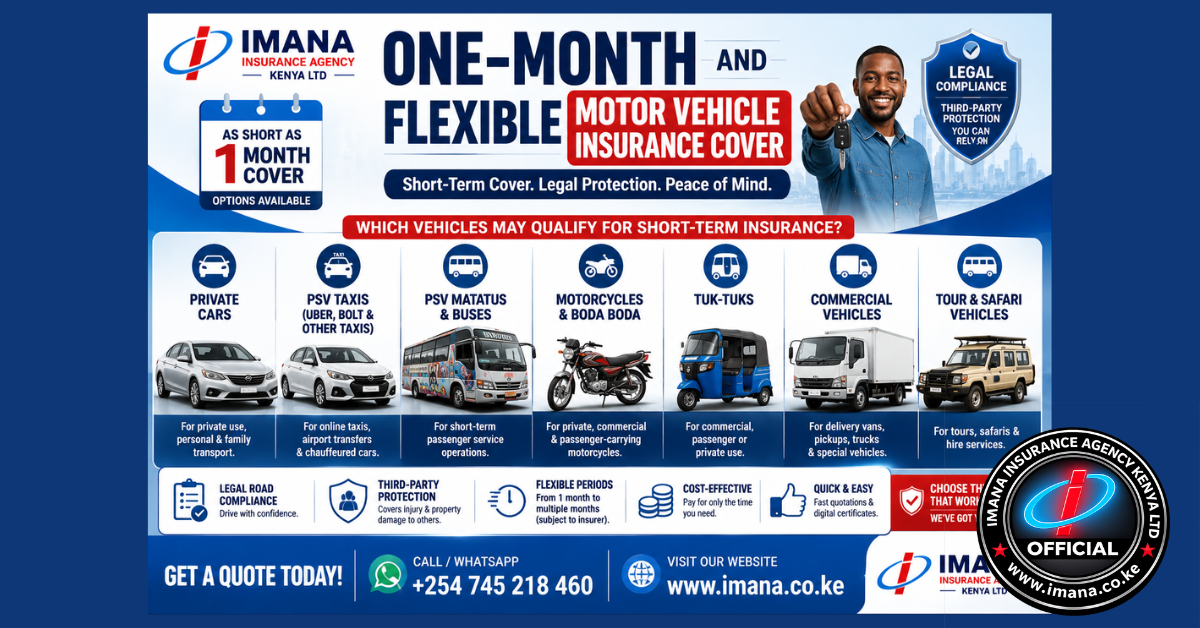
Which Vehicles May Qualify for Short-Term Insurance?
Availability depends on the insurer, but short-period cover may be considered for several classes.
1. Private cars
A private saloon car, station wagon or SUV may qualify for short-term Third-Party Insurance where the insurer offers it.
The vehicle must genuinely be used for:
- Private purposes
- Social use
- Domestic use
- Personal commuting, where permitted
It should not be insured as private if it is being used for:
- Taxi work
- Deliveries
- Tour operations
- Passenger transport for payment
- General commercial activity
2. PSV taxis
Short-term cover may be relevant to:
- Conventional taxis
- Uber vehicles
- Bolt vehicles
- Other online taxis
- Airport-transfer cars
- Chauffeur-driven vehicles
The policy must clearly reflect commercial passenger use.
3. PSV matatus and buses
Passenger-service vehicles may have limited-duration options, subject to:
- Correct seating capacity
- Valid inspection
- Driver and vehicle licensing
- Route or operational information
- Insurer acceptance
4. Motorcycles
Short-term motorcycle insurance may be available for:
- Private motorcycles
- Commercial delivery motorcycles
- Boda boda motorcycles
- PSV motorcycles
A motorcycle carrying paying passengers should not be insured under a private motorcycle class. Incorrect classification can affect the validity and handling of a claim.
5. Tuk-Tuks
A Tuk-Tuk may be insured as:
- Commercial vehicle
- Passenger-service vehicle
- Private vehicle, where genuinely applicable
The correct class depends on its actual operation.
6. Commercial vehicles
Limited-duration cover may sometimes be available for:
- Own-goods vehicles
- Delivery vans
- Pickups
- Trucks
- Special-type vehicles
Commercial availability is highly insurer-specific and must be confirmed through a current quotation.
What Does Short-Term Third-Party Insurance Cover?
Short-term Third-Party Only insurance generally performs the same basic function as annual Third-Party Insurance, but for a shorter policy period.
It may cover eligible legal liability involving:
- Bodily injury to third parties
- Death of third parties
- Damage to third-party property
- Passenger liability where required and included
- Related legal expenses, subject to the policy
Kenyan law requires compliant third-party insurance before a motor vehicle is used on a road.
The policy wording and applicable statutory limits determine how a claim is handled.
What Short-Term Third-Party Cover Does Not Protect
A standard short-term Third-Party policy does not ordinarily cover:
- Accidental damage to your own vehicle
- Theft of your vehicle
- Fire damage to your vehicle
- Flood damage
- Windscreen damage
- Mechanical breakdown
- Towing expenses
- Loss of use
- Personal belongings inside the vehicle
- Routine maintenance
Third-Party Only insurance protects specified liabilities involving other people; it does not insure the physical value of your own vehicle. Imana’s motor-insurance guidance distinguishes this from Comprehensive cover, which may insure accidental damage, fire, theft, flood and third-party liability.
Can Comprehensive Motor Insurance Be Purchased Short-Term?
Short-term Comprehensive Insurance may be less widely available than short-term Third-Party cover.
Some insurers may:
- Offer only annual Comprehensive policies.
- Offer shorter periods for selected risks.
- Apply a disproportionately high minimum premium.
- Require full valuation and inspection.
- Restrict short-period Comprehensive cover to special circumstances.
Where available, short-term Comprehensive cover may still require:
- Vehicle valuation
- Inspection
- Photographs
- Security information
- Full proposal details
- Payment of applicable minimum premium
A customer should not assume that a three-month Comprehensive policy will cost exactly one quarter of an annual premium. Insurers may apply minimum premiums, administrative charges and short-period rating factors.
Who May Benefit From Short-Term Motor Insurance?
A motorist awaiting a vehicle sale
Where a vehicle may be sold shortly but still needs to be driven, a limited policy can provide lawful road cover during the interim period.
A new vehicle owner completing transfer
A purchaser may require temporary protection while ownership and registration documents are being completed. The transfer-related temporary-cover rules should be observed.
A PSV owner returning a vehicle to operation
A taxi, matatu or motorcycle owner may need one month of cover while:
- Testing the viability of returning to business
- Awaiting a longer-term contract
- Managing temporary cash flow
- Preparing for annual renewal
A seasonal operator
Some vehicles operate mainly during:
- School terms
- Tourism seasons
- Agricultural seasons
- Temporary projects
- Special events
A motorist with an immediate insurance gap
A short-period policy may provide temporary lawful protection while the owner compares annual quotations.
This should not become a pattern of continuously allowing cover to expire and driving uninsured between policies.
When Annual Motor Insurance May Be Better
Short-term insurance is convenient, but an annual policy may be more economical and reliable for a vehicle used throughout the year.
Annual cover may be more suitable where:
- The vehicle is used regularly.
- The owner wants uninterrupted protection.
- The business depends on the vehicle.
- The vehicle is financed.
- Comprehensive cover is required.
- The owner wants optional extensions.
- Repeated monthly renewals would become expensive.
Buying several short-term policies may ultimately cost more than one annual policy because each certificate may attract:
- Minimum premium
- Policy charges
- Levies
- Administrative costs
- Short-period rating
The motorist should compare the total yearly cost rather than only the immediate monthly payment.
Short-Term Insurance Is Not Motor Premium Instalment Financing
These are two different arrangements.
Short-term policy
The insurance expires after the selected short period. A new policy or renewal is required to continue cover.
Annual policy paid by instalments
The policy may run for 12 months, but the premium is paid according to an approved instalment schedule.
Failure to pay an instalment may affect the policy, depending on the insurer’s terms.
A customer struggling with the annual premium should compare:
- One-month cover
- Three-month cover, where available
- Annual policy with instalments
- Third-Party Only annual cover
- Comprehensive annual cover
The cheapest immediate option may not offer the lowest total annual cost.
How Much Does Short-Term Motor Insurance Cost in Kenya?
There is no universal short-term motor-insurance price.
The cost may depend on:
- Vehicle class
- Private, commercial or PSV use
- Seating capacity
- Policy duration
- Third-Party or Comprehensive cover
- Insurer
- Claims history
- Driver profile
- Minimum premium
- Statutory levies and charges
A private car cannot be priced in the same way as:
- An online taxi
- A matatu
- A motorcycle
- A commercial truck
- A tour van
- A school bus
Rates may change, so customers should request a current written quotation rather than relying on an old certificate, poster or social-media price.
Documents Required for Short-Term Motor Insurance
The insurer or intermediary may request:
- National ID or passport
- KRA PIN
- Vehicle logbook or eLogbook
- Vehicle registration number
- Vehicle make and model
- Year of manufacture
- Engine capacity
- Seating capacity
- Intended use
- Previous insurance details
- Claims history
- Preferred policy duration
- Required cover start date
Additional requirements may apply to PSVs, commercial vehicles and motorcycles, including:
- Inspection documents
- Driver details
- PSV documentation
- Platform information for online taxis
- Route information
- Company documents
- Owner’s authority
For Comprehensive cover, the insurer may also request:
- Vehicle valuation
- Photographs
- Anti-theft information
- Inspection report
Important Checks Before Paying
Before purchasing a short-term certificate, confirm:
Correct vehicle registration
A single incorrect letter or number may create difficulties during verification or claims.
Correct vehicle class
Ensure the certificate correctly describes the vehicle as:
- Private
- Commercial
- PSV taxi
- PSV bus
- Motorcycle
- Tuk-Tuk
- Tour service
- Special type
Correct start and expiry dates
Do not assume that cover starts immediately merely because payment has been made.
Correct passenger capacity
This is especially important for taxis, motorcycles, buses and tour vehicles.
Licensed insurer
Purchase cover from a licensed insurer through an authorised intermediary. The Insurance Regulatory Authority regulates and licenses Kenya’s insurance market participants. (Insurance Regulatory Authority)
Official payment channel
Avoid paying premiums into unidentified personal accounts.
Policy verification
Check that the certificate is authentic and properly recorded in the insurer’s system.
What Happens When Short-Term Cover Expires?
Once the stated expiry date passes:
- The vehicle no longer has protection under that certificate.
- The vehicle should not be used on a road without replacement insurance.
- A later renewal does not ordinarily backdate cover for an uninsured period.
- An accident occurring after expiry may not be covered.
Set a reminder several days before expiry.
Short-term policyholders may forget renewal more easily because their cover expires sooner than a conventional annual policy.
Can You Renew a One-Month Policy Repeatedly?
This depends on:
- Insurer rules
- Vehicle class
- Claims history
- Regulatory requirements
- Underwriting approval
Although a commercial short-period product may be renewable, repeatedly purchasing one-month cover may be:
- More expensive over a full year
- Administratively inconvenient
- Vulnerable to accidental gaps
- Unsuitable for financed vehicles
- Restricted by some insurers
The specific statutory temporary cover issued while ownership transfer is pending is subject to separate restrictions and should not be treated as endlessly renewable monthly insurance. (Kenya Law)
Can a Short-Term Policy Be Upgraded?
A motorist may request an upgrade from short-term Third-Party cover to annual or Comprehensive Insurance, subject to insurer approval.
The process may require:
- Updated proposal information
- Vehicle valuation
- Physical inspection
- Additional premium
- New certificate
- Cancellation or replacement of the earlier policy
Never assume that paying an additional amount automatically changes the cover.
Obtain an official endorsement, policy schedule or replacement certificate.
What to Do After an Accident
1. Confirm that everyone is safe
Arrange emergency assistance for injured people.
2. Secure the scene
Use hazard lights and reflective triangles where safe.
3. Photograph the accident
Capture:
- Vehicle positions
- Registration plates
- Damage
- Road conditions
- Third-party property
- Traffic signs
4. Exchange information
Record:
- Driver names
- Telephone numbers
- Insurance details
- Vehicle-owner details
- Witness contacts
5. Report to the police
Obtain the required police report or abstract.
6. Notify the insurer immediately
Provide:
- Policy number
- Certificate number
- Vehicle registration
- Accident location
- Date and time
- Third-party details
7. Avoid admitting liability
Provide factual information without promising private compensation.
8. Preserve all documents
Keep photographs, correspondence, police records and claim forms.
Short-term status does not remove the normal claims-notification and documentation requirements.
Common Mistakes to Avoid
Buying the wrong vehicle class
A private certificate should not be used for taxi, delivery, safari or passenger operations.
Allowing the policy to expire unnoticed
Record the exact expiry date and arrange replacement cover early.
Assuming your own car is protected
Third-Party Only insurance does not ordinarily pay for damage to the insured vehicle.
Choosing monthly cover without comparing annual cost
Several monthly policies may be more expensive than one annual policy.
Entering incorrect registration details
Review every detail before accepting the certificate.
Driving before cover begins
Confirm the commencement date and payment status.
Treating a cover note as permanent insurance
Obtain the full policy or certificate required for the relevant transaction.
Buying from an unverified seller
Confirm the insurer, intermediary, payment channel and certificate authenticity.
Frequently Asked Questions
Is one-month car insurance available in Kenya?
It may be available for selected vehicle classes and insurers, particularly under Third-Party motor arrangements. Product availability must be confirmed through a current quotation.
Is short-term insurance legally valid?
Yes, provided it is issued by an authorised insurer, meets the applicable motor-insurance requirements and remains in force on the date the vehicle is used.
Does monthly motor insurance cover my own vehicle?
Not where the policy is Third-Party Only. Own-vehicle damage generally requires Comprehensive or another applicable own-damage policy.
Can Uber and Bolt vehicles obtain short-term insurance?
Potentially, subject to insurer acceptance. The vehicle must be insured under the correct online-taxi or commercial passenger class.
Can a boda boda obtain one-month insurance?
Some insurers may offer short-term motorcycle or PSV motorcycle options. The owner should confirm the available period and correct class.
Can I use a short-term private certificate for taxi work?
No. The policy must reflect the vehicle’s actual commercial passenger use.
Can short-term motor insurance include fire and theft?
It may be available where an insurer offers short-term Third-Party, Fire and Theft or Comprehensive protection. It is not included automatically.
Is a temporary cover note the same as a policy?
Not always. A cover note may provide interim evidence while formal policy documentation is being completed. Confirm its purpose, limits and expiry date.
Can I buy a short-term policy online?
Many quotation and document-submission processes can begin digitally, subject to insurer verification and underwriting.
Is annual insurance cheaper?
It may be more economical for a vehicle used throughout the year. Compare the total cost and benefits of both arrangements.
Compare Short-Term Motor Insurance Through Imana
Imana Insurance Agency Kenya Ltd helps motorists compare short-term and annual motor-insurance quotations from suitable licensed insurers.
Available enquiries may include:
- Private car insurance
- Commercial motor insurance
- PSV taxi insurance
- Uber and Bolt insurance
- Motorcycle and boda boda insurance
- Tuk-Tuk insurance
- Tour and safari vehicle insurance
- Matatu and bus insurance
- Comprehensive Insurance
- Third-Party Only Insurance
- Third-Party, Fire and Theft
- COMESA Yellow Card
Useful Imana links
- Motor Insurance: www.imana.co.ke/insurance/motor-insurance
- Request a Motor Quote: www.imana.co.ke/motor-quote
- PSV Insurance: www.imana.co.ke/psv-insurance
- Motorcycle Insurance: www.imana.co.ke/motorcycle-insurance
- Report a Claim: www.imana.co.ke/claims-request
- Website: www.imana.co.ke
Imana’s online motor quotation form allows customers to select Comprehensive, Third-Party Only or Third-Party Fire and Theft and provide the proposed start date and vehicle information.
Contact Imana Insurance Agency Kenya Ltd
Office: 4th Floor, Krishna Centre, Woodvale Grove, Westlands, Nairobi
Call/WhatsApp: +254 796 209 402 | +254 745 218 460
Website: www.imana.co.ke
Need insurance for one month or the full year? Compare the total cost, confirm the correct class and keep your vehicle legally protected.
Short-term motor-insurance availability, duration, premiums, vehicle classes, benefits and renewal conditions vary by insurer. Obtain a current written quotation, official certificate and full policy wording before using the vehicle.