Blog Details
Diskava. Beta. Kava
10Sep
Public Liability Insurance Kenya: Cover & Who Needs It
Learn what public liability insurance covers in Kenya, who needs it, common exclusions, claims steps and how businesses can compare quotations.
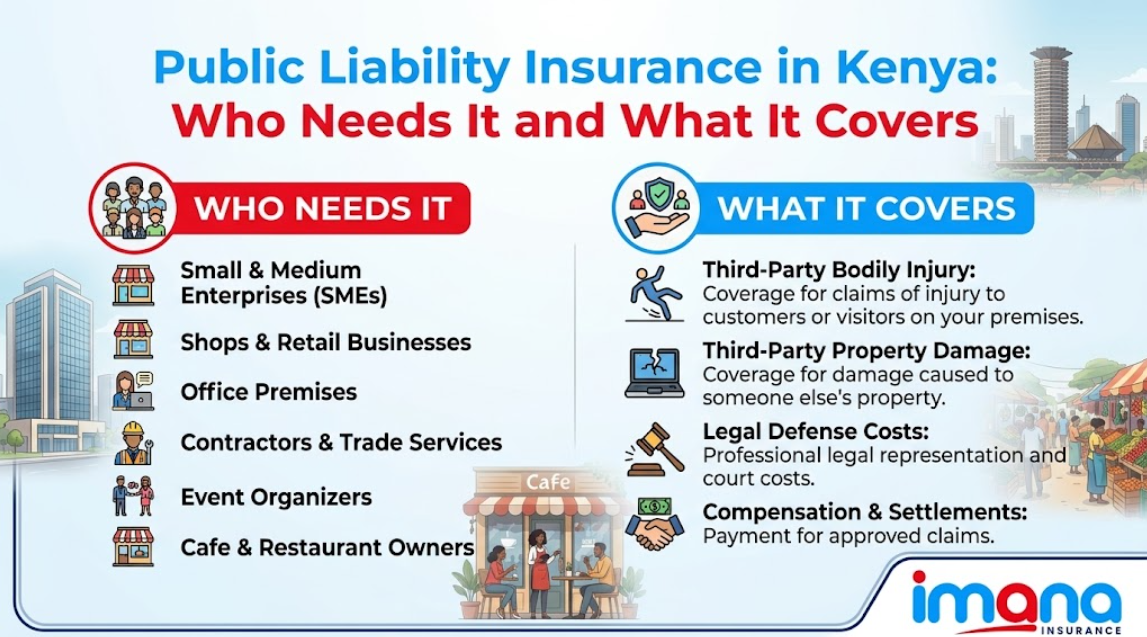
Public Liability Insurance in Kenya: Who Needs It and What It Covers
A customer slips on a wet restaurant floor. A visitor is struck by falling stock inside a shop. Construction debris damages a neighbouring property. A guest is injured during an event. A child is hurt while visiting school premises.
In each case, the affected person may allege that a business, property owner, contractor or event organiser was negligent.
The resulting claim may involve medical expenses, property-repair costs, legal representation and court-awarded compensation. Without suitable insurance, these expenses may have to be paid directly by the organisation or individual held legally liable.
Public liability insurance in Kenya is designed to protect an insured business or organisation against specified claims arising from accidental bodily injury or accidental property damage suffered by third parties in connection with the insured’s activities.
This guide explains who may need public liability insurance, what it ordinarily covers, its common exclusions, how premiums are determined and what to do when an incident occurs.
What Is Public Liability Insurance?
Public liability insurance protects an insured party against legal liability for accidental:
- Death or bodily injury suffered by a third party
- Loss of or damage to third-party property
- Legal defence costs associated with a covered claim
- Claimant costs awarded against the insured
Cover applies subject to the policy wording, territorial limits, policy period, insured activities, liability limit, excess and exclusions.
A third party may be a customer, supplier, visitor, contractor, spectator, neighbouring property owner or member of the public.
Employees are normally handled separately under WIBA, employers’ liability or Group Personal Accident insurance rather than public liability insurance.
Why Public Liability Matters in Kenya
Businesses regularly interact with customers, visitors, suppliers and neighbouring property owners. Even a carefully managed organisation cannot eliminate every accident.
Kenya’s Occupiers’ Liability Act establishes a duty of care owed by occupiers of premises to their visitors. An occupier generally needs to take reasonable care to ensure that visitors will be reasonably safe while using the premises for the purposes for which they were invited or permitted to be there.
Public liability insurance does not remove this duty. It provides financial protection when an insured organisation faces an eligible third-party claim.
A business may also be required to produce evidence of public liability insurance before it can:
- Sign a commercial lease
- Enter a shopping mall or managed building
- Begin a construction contract
- Participate in a tender
- Hold an event at a venue
- Supply services to a large company
- Work at a client’s premises
- Obtain approval under a commercial agreement
- Operate as a contractor or subcontractor
Public liability insurance is not automatically compulsory for every business in Kenya. Requirements can arise from contracts, tenancy agreements, sector rules, client conditions, procurement documents or the nature of a particular activity.
What Does Public Liability Insurance Cover?
The scope of cover differs between insurers, but a standard public liability policy may respond to the following areas.
Accidental Bodily Injury
The policy may cover legal liability when a third party is accidentally injured in connection with the insured business.
Examples include:
- A customer slipping on an unmarked wet floor
- A hotel guest falling on a damaged staircase
- A visitor being injured by falling merchandise
- A spectator being hurt during an insured event
- A patient’s relative being injured by defective furniture
- A member of the public being struck by construction material
The insurer will investigate whether the insured is legally liable. The occurrence of an accident does not, by itself, prove negligence.
Accidental Third-Party Property Damage
Public liability insurance may cover accidental damage to property belonging to another person or organisation.
Examples include:
- A contractor damaging a neighbouring building
- Water from business premises damaging a tenant’s property
- Event equipment damaging a venue
- A falling shop sign damaging a customer’s property
- Renovation work damaging an adjoining office
- Fire originating from insured premises damaging neighbouring property
Property owned by, leased to or held in the custody or control of the insured may be excluded or require different insurance.
Legal Defence Costs
Defending a liability claim can be expensive even when the insured believes it was not negligent.
Subject to the policy wording and insurer’s prior approval, public liability insurance may pay reasonable legal costs incurred in investigating and defending a covered claim.
The insured should not appoint lawyers, admit liability or negotiate a settlement without involving the insurer.
Compensation and Court Awards
Where the insured is found legally responsible, the policy may pay eligible compensation awarded to the claimant, up to the applicable limit of indemnity.
Any amount exceeding the policy limit remains the insured’s responsibility.
Claimant’s Legal Costs
A court may require the unsuccessful party to pay some of the claimant’s legal costs. These costs may be covered where they arise from an insured claim and fall within the policy terms.
What Is a Limit of Indemnity?
The limit of indemnity is the maximum amount the insurer will pay under the policy, subject to its terms.
A business may select limits such as KES 1 million, KES 5 million, KES 10 million, KES 20 million or higher, depending on the insurer and risk.
Some policies apply one limit to each occurrence and another aggregate limit to all claims made during the policy period.
The right limit should reflect:
- Maximum number of visitors at one time
- Possible severity of bodily injury
- Value of neighbouring property
- Contractual requirements
- Size and nature of the premises
- Type of work performed
- Use of machinery, heat or hazardous materials
- Event attendance
- Claims history
- Insurer’s underwriting requirements
A KES 1 million limit may be inadequate if an incident injures several people or damages an expensive neighbouring property.
Who Needs Public Liability Insurance in Kenya?
Any organisation whose premises, activities or services could accidentally injure a third party or damage third-party property should consider public liability cover.
The following sectors commonly face public-liability exposures.
1. Restaurants, Cafés and Hotels
Restaurants and hotels receive members of the public every day. Common risks include:
- Slips and falls
- Burns from hot food or drinks
- Falling objects
- Defective furniture
- Wet bathroom floors
- Swimming-pool accidents
- Damaged staircases
- Property damage affecting guests
- Accidents in parking or common areas
Public liability should be considered alongside fire and perils, burglary, money insurance, business interruption, machinery breakdown, fidelity guarantee, WIBA, employer’s liability and food-related product liability.
2. Schools and Educational Institutions
Schools, colleges, training centres and day-care facilities host students, parents, suppliers and visitors.
Possible claims may arise from:
- Unsafe stairways
- Playground equipment
- School events
- Falling fixtures
- Defective furniture
- Open trenches
- Slippery floors
- Visitor injuries
- Damage caused to third-party property
Public liability does not replace student personal accident insurance. The two covers respond to different risks.
3. Events and Event Organisers
Weddings, conferences, exhibitions, concerts, sports events, festivals and corporate activations can bring many people into one location.
Risks include:
- Crowd-related injuries
- Temporary structures collapsing
- Electrical cables causing falls
- Damage to the venue
- Falling lighting or sound equipment
- Food-service incidents
- Accidents involving contractors
- Injuries caused by displays or installations
Venues may require organisers to provide a public liability certificate before an event begins.
The proposal should disclose the event type, location, dates, expected attendance, security arrangements, structures, contractors and activities.
4. Shops, Supermarkets and Shopping Malls
Retail businesses face continuous interaction with customers and suppliers.
Common exposures include:
- Wet floors
- Goods falling from shelves
- Escalator or lift incidents
- Trolleys causing injury or damage
- Defective doors
- Signs falling
- Obstructions in walkways
- Injuries in common areas
- Accidents during loading and unloading
Mall owners and property managers should establish which risks are insured by the landlord and which must be covered by individual tenants.
5. Contractors and Construction Businesses
Contractors can cause serious injury or property damage while working at project sites or clients’ premises.
Examples include:
- Materials falling onto members of the public
- Excavation damaging underground services
- Construction work damaging neighbouring buildings
- Tools injuring visitors
- Dust, vibration or water damaging adjacent property
- Temporary structures collapsing
- Machinery damaging third-party property
Public liability may be purchased as a standalone policy or incorporated into Contractors All Risks insurance.
Contractors may also need WIBA, employer’s liability, Contractors Plant and Machinery insurance, Professional Indemnity, motor insurance, performance bonds and advance-payment bonds.
6. Landlords and Property Owners
Landlords may face liability claims relating to common areas, structural defects or poor property maintenance.
Risks may include:
- Broken staircases
- Defective railings
- Falling roof materials
- Poorly maintained common areas
- Open electrical installations
- Water escaping into neighbouring premises
- Visitors being injured in corridors or parking areas
- Falling signs or fixtures
Property owners should distinguish between buildings insurance, landlord’s liability, loss-of-rent cover and public liability insurance.
7. Offices and Professional Businesses
An office may appear low-risk, but visitors, interview candidates, clients, technicians and delivery personnel can still be injured.
Possible incidents include:
- Slips on polished or wet floors
- Loose electrical cables
- Defective chairs
- Falling shelves
- Broken glass
- Unsafe staircases
- Property damage during meetings or off-site work
Professional businesses should remember that public liability and professional indemnity insurance are different.
Public liability deals mainly with accidental bodily injury and physical property damage. Professional indemnity addresses claims arising from professional advice, errors, omissions or negligent services.
8. Hospitals, Clinics and Medical Facilities
Hospitals, clinics, pharmacies, laboratories and diagnostic centres receive patients and visitors who may be vulnerable to injury.
Public-liability exposures may include:
- Slips and falls
- Defective waiting-room furniture
- Unsafe corridors
- Falling equipment
- Visitor injuries
- Damage to third-party property
- Accidents in parking or reception areas
Public liability does not replace medical malpractice or professional indemnity insurance. Allegations involving diagnosis, treatment or professional medical services normally require specialist professional-liability cover.
Other Businesses That Should Consider Cover
Public liability may also be relevant to:
- Gyms and fitness centres
- Salons and barbershops
- Warehouses
- Manufacturers
- Churches and religious organisations
- NGOs
- Cleaning companies
- Security firms
- Property managers
- Garages and workshops
- Tour operators
- Conference facilities
- Clubs and entertainment venues
- Apartment management companies
- Repair and maintenance businesses
The key question is simple: could the organisation’s premises or activities accidentally injure someone outside its workforce or damage property belonging to another party?
If the answer is yes, a public-liability exposure exists.
What Public Liability Insurance Does Not Normally Cover
Public liability insurance is not an all-risk policy.
Common exclusions may include:
- Injury to employees
- Damage to the insured’s own property
- Professional advice, errors or omissions
- Product defects after goods leave the insured’s control
- Motor-vehicle liability
- Deliberate or criminal acts
- Fines and penalties
- Contractual liability beyond ordinary legal liability
- Pollution unless specifically included
- Gradual environmental damage
- War, terrorism or political violence unless extended
- Cyber incidents
- Damage to property in the insured’s custody or control
- Known circumstances existing before the policy began
- Claims outside the territorial or jurisdictional limits
- Activities not declared to the insurer
Exact exclusions vary. Applicants should read the quotation, schedule, policy wording and endorsements.
Public Liability Versus WIBA Insurance
Public liability protects against specified claims made by members of the public and other third parties.
WIBA insurance addresses an employer’s statutory liability when an employee suffers occupational injury, disease, disablement or death arising from employment.
A business with employees and public interaction may require both covers.
Public Liability Versus Professional Indemnity
Public liability generally responds to accidental third-party bodily injury or physical property damage.
Professional indemnity protects professionals and businesses against claims arising from negligent advice, errors, omissions or breach of professional duty.
A consultant who gives incorrect professional advice may require professional indemnity. A client who slips inside the consultant’s office may create a public-liability claim.
Public Liability Versus Product Liability
Public liability ordinarily focuses on accidents arising from business operations or premises.
Product liability addresses injury or property damage caused by products manufactured, supplied, sold, repaired or distributed by the insured.
Restaurants, food manufacturers, retailers, importers and distributors should confirm whether product liability is included or must be purchased separately.
Public Liability Versus Motor Third-Party Insurance
Public liability does not replace compulsory motor third-party insurance.
Claims arising from the use of an insured motor vehicle should ordinarily fall under the relevant motor policy, subject to its terms.
Businesses operating delivery vehicles, taxis, motorcycles, trucks or company cars need appropriate motor insurance separately.
How Much Does Public Liability Insurance Cost in Kenya?
There is no universal price.
Insurers calculate premiums after considering the organisation’s actual exposure. Important rating factors include:
- Nature of the business
- Annual turnover
- Number of visitors
- Number and location of premises
- Limit of indemnity
- Claims history
- Contract value
- Project duration
- Event attendance
- Use of machinery
- Hazardous activities
- Neighbouring properties
- Height or depth of construction work
- Selected extensions
- Excess
- Territorial scope
A small professional office will not normally present the same risk as a construction contractor, hospital, shopping mall or large public event.
Information Required for a Quotation
An insurer may request:
- Full business name
- KRA PIN
- Certificate of incorporation or business registration
- Physical and postal address
- Description of business activities
- Annual turnover
- Number of employees
- Estimated annual visitor numbers
- Number and type of premises
- Required limit of indemnity
- Previous claims
- Existing insurance history
- Contract or tender requirements
- Event details
- Project details
- Risk-management measures
- Completed proposal form
Incomplete descriptions can lead to unsuitable quotations or claim disputes. Declare every material activity, including work performed away from the main premises.
How to Choose an Appropriate Limit
Avoid selecting a limit solely because it produces the lowest premium.
Consider the worst reasonably foreseeable incident:
- How many people could be injured?
- Could an incident affect neighbouring property?
- What is the value of nearby buildings or equipment?
- Does a client specify a minimum limit?
- Could one occurrence produce several claims?
- Does the aggregate limit reset after each claim?
- Are legal costs included within or paid in addition to the limit?
A restaurant with 20 seats, a mall receiving thousands of visitors and a contractor working beside an occupied commercial building require different limits.
Risk Management Still Matters
Insurance should support—not replace—safety management.
Businesses can reduce public-liability incidents by:
- Displaying warning signs
- Cleaning spills immediately
- Maintaining staircases and railings
- Keeping exits and walkways clear
- Inspecting electrical installations
- Securing shelves and signs
- Maintaining visitor registers
- Controlling contractor access
- Documenting inspections
- Training employees on incident reporting
- Preserving CCTV footage
- Providing adequate lighting
- Restricting access to hazardous areas
- Maintaining fire and emergency equipment
Insurers may consider risk-management controls when deciding whether to offer cover and on what terms.
What to Do After an Accident
When an incident occurs:
- Attend to injured persons and obtain emergency assistance.
- Prevent further injury or property damage.
- Record the date, time and location.
- Collect names and contact details of witnesses.
- Take photographs or video where appropriate.
- Preserve CCTV footage.
- Record the condition of the scene.
- Notify management and the insurer or intermediary promptly.
- Forward demand letters, summonses or correspondence immediately.
- Cooperate with the insurer’s investigation.
Do not:
- Admit legal liability
- Promise compensation
- Sign a private settlement
- Alter evidence
- Ignore a demand letter
- Delay reporting
- Post confidential details about the claimant online
Expressions of concern and reasonable emergency assistance should not be confused with accepting legal liability.
How a Public Liability Claim Is Assessed
The insurer may investigate:
- Whether the policy was active
- Whether the business activity was declared
- Whether the incident occurred within the insured territory
- Whether the claimant is a third party
- Whether the insured owed the claimant a duty of care
- Whether that duty was breached
- Whether the breach caused the injury or damage
- Whether the claim falls within an exclusion
- Whether the insured complied with notification requirements
- The value of the alleged loss
- The applicable excess and liability limit
Not every accident produces a valid public-liability claim. Liability must normally be established from the facts and applicable law.
Common Reasons Claims Become Difficult
A claim may be delayed, disputed or declined where:
- The incident was reported late
- The insured admitted liability without approval
- The relevant activity was not disclosed
- The policy had expired
- The claim falls under another insurance class
- Important evidence was lost
- The insured failed to cooperate
- The loss falls within an exclusion
- The claimant’s loss is not supported by documents
- The selected limit is inadequate
- The incident occurred outside the covered territory
- The policy conditions were breached
Prompt reporting and accurate documentation can make a major difference.
How to Compare Public Liability Insurance Quotations
Do not compare price alone.
Review:
- Limit of indemnity
- Aggregate limit
- Excess
- Covered business description
- Territorial limits
- Jurisdiction
- Legal defence costs
- Extensions
- Exclusions
- Products liability
- Food and drink liability
- Tenants’ liability
- Property in custody or control
- Work-away risk
- Contractor and subcontractor conditions
- Claims-reporting requirements
Two quotations with the same premium can provide materially different protection.
Compare business insurance quotations through:
How to Apply for Public Liability Insurance
The quotation pathway should be simple:
Step 1: Describe the Risk
Provide accurate information about the organisation, premises, activities, visitors, turnover, contracts and previous claims.
Step 2: Select a Limit
Choose a liability limit that reflects the exposure and any contractual requirement.
Step 3: Compare Quotations
Compare premiums, limits, exclusions, excesses and extensions from suitable licensed Kenyan insurers.
Step 4: Complete the Proposal
Answer all questions fully and disclose material facts.
Step 5: Pay the Premium
Use the insurer’s or authorised intermediary’s approved payment channel.
Step 6: Confirm Cover
Check the policy schedule, insured name, business description, address, period, limit and endorsements.
Frequently Asked Questions
Is public liability insurance compulsory in Kenya?
It is not universally compulsory for every Kenyan business. However, it may be required under a lease, tender, contract, venue agreement, sector condition or client requirement.
Does public liability cover employees?
Employees are ordinarily covered under WIBA, employers’ liability or other employee-related insurance rather than public liability.
Does it cover customers who fall inside business premises?
It may cover legal liability arising from an accidental customer injury, subject to negligence being established and the policy terms being satisfied.
Does it cover damage to neighbouring property?
Potentially, where the insured becomes legally liable for accidental physical damage and no exclusion applies.
Does it pay every person injured at the premises?
No. The insurer assesses the circumstances, legal liability, evidence and policy conditions.
Does it cover professional mistakes?
Ordinarily no. Professional errors and negligent advice require professional indemnity insurance.
Does it cover defective products?
Product liability may need to be included as an extension or purchased separately.
Can event organisers buy short-period cover?
Insurers may offer event-specific cover based on the venue, attendance, activities and event duration.
Can a landlord and tenant both need cover?
Yes. Their legal responsibilities and insured interests may be different. The lease should be reviewed carefully.
Can public liability be included in another policy?
It may form part of a combined business policy, Contractors All Risks policy, office package, hospitality policy or another commercial package.
Build a Complete Business Insurance Programme
Public liability is only one part of business risk management.
Depending on the organisation, additional policies may include:
- Fire and perils
- Burglary
- Business interruption
- WIBA
- Employer’s liability
- Group Personal Accident
- Professional Indemnity
- Product Liability
- Cyber Insurance
- Fidelity Guarantee
- Money Insurance
- Marine Cargo
- Goods in Transit
- Contractors All Risks
- Motor Insurance
- Machinery Breakdown
- Electronic Equipment Insurance
The objective is not to collect policies. It is to identify exposures and close the gaps between them.
Get a Public Liability Insurance Quote in Kenya
Imana Insurance Agency Kenya Ltd is a Westlands-based insurance intermediary helping individuals, families and businesses compare insurance quotations from licensed Kenyan insurers across Motor, Medical, WIBA, PSV, Travel, Motorcycle, Cyber, SME/Corporate and other insurance classes.
For public liability insurance, provide:
- Nature of business
- Location
- Annual turnover
- Visitor numbers
- Required liability limit
- Previous claims
- Contract, project or event details
Compare insurance quotations:
https://imanainsurance.com
Insurance authority and information centre:
https://imana.co.ke
Travel and insurance solutions:
https://mykava.co.ke
Visit:
Imana Insurance Agency Kenya Ltd
4th Floor, Krishna Centre
Woodvale Grove, Westlands
Nairobi, Kenya
Call/WhatsApp: +254 745 218 460
Terms, conditions, exclusions, excesses and underwriting requirements apply. The insurer determines acceptance of risk and settlement of valid claims.
Author: Raymond Momanyi
Founder & CEO, Imana Insurance Agency Kenya Ltd
Raymond Momanyi is an insurance professional specialising in motor insurance, medical insurance, WIBA, PSV insurance comparison, claims support and business-risk solutions in Kenya.