Blog Details
Diskava. Beta. Kava
05Aug
COMESA Yellow Card Insurance in Kenya and Covered Countries Explained
Get COMESA Yellow Card Insurance in Kenya for cross-border road travel. Learn what it covers, recognised countries, requirements, claims and how to obtain a quotation.
COMESA Yellow Card Insurance in Kenya: Coverage, Countries and Requirements
COMESA Yellow Card Insurance in Kenya is a regional third-party motor insurance solution for motorists driving Kenyan-registered vehicles into participating countries in Eastern and Southern Africa.
It helps a visiting motorist meet compulsory third-party motor insurance requirements when entering or transiting through another participating country. Instead of purchasing separate third-party insurance at every border, the motorist travels with one recognised regional certificate for the insured countries and period.
The scheme mainly protects third parties who suffer bodily injury, death or property damage following a road accident caused by the visiting insured vehicle. Compensation is handled according to the compulsory motor insurance laws and applicable limits of the country where the accident occurs. (COMESA)
Imana Insurance Agency Kenya Ltd helps motorists arrange COMESA Yellow Card Insurance before leaving Kenya. MyKava Travel & Insurance can support the wider journey through accommodation, travel planning, airport transfers and other travel services.
What Is the COMESA Yellow Card?
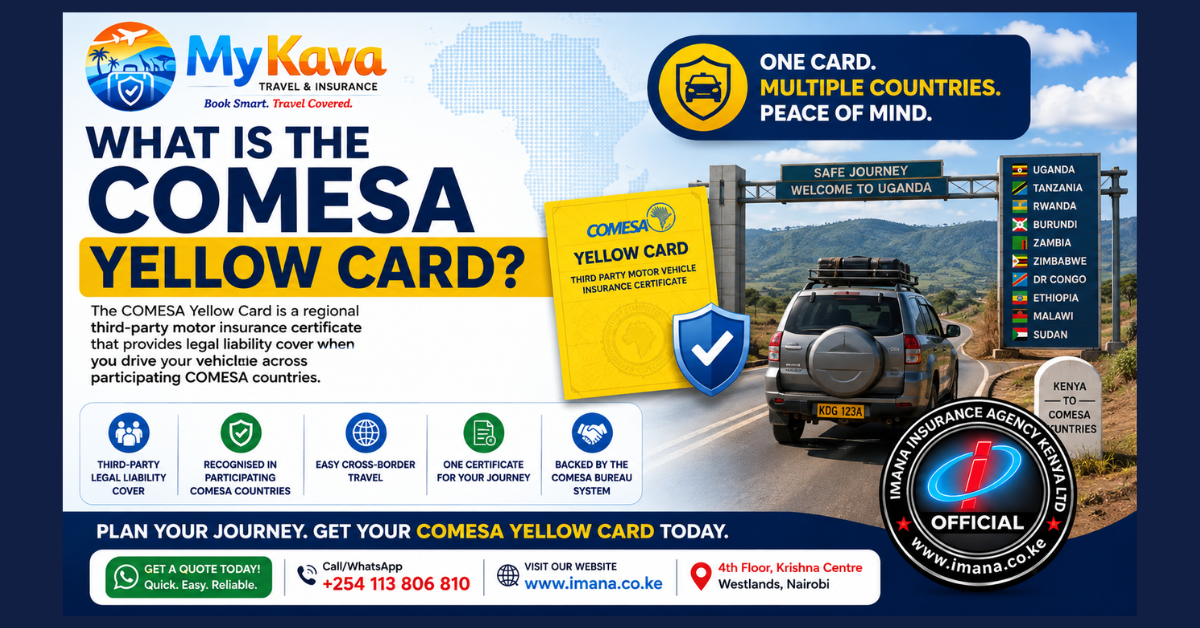
The COMESA Yellow Card is a regional third-party motor vehicle insurance certificate recognised by countries participating in the Yellow Card Scheme.
It was developed to make cross-border travel easier by establishing a common third-party motor insurance system for vehicles moving between participating countries. A valid Yellow Card issued in one participating country can be recognised in the other countries shown within the scheme, subject to the certificate’s dates and territorial scope. (COMESA)
The scheme supports:
- Cross-border movement of private vehicles
- Commercial transport
- Regional trade and logistics
- Tourist road trips
- Motorcycle travel
- Movement of people and goods
- Third-party accident compensation
- Coordinated claims between participating countries
It does not replace every type of motor insurance. Its principal purpose is to provide third-party legal liability protection when the insured vehicle is driven across participating borders.
Why Do Kenyan Motorists Need a COMESA Yellow Card?
A Kenyan motor insurance policy is primarily issued under Kenyan law.
Once a Kenyan vehicle crosses into another country, the motorist must comply with the compulsory third-party motor insurance laws of the country being visited.
A COMESA Yellow Card helps provide evidence that the vehicle has recognised regional third-party protection.
It may help a motorist avoid:
- Buying separate third-party policies at several borders
- Carrying multiple national motor certificates
- Delays arising from missing cross-border insurance
- Confusion after an accident in a foreign country
- Difficulty identifying the responsible claims bureau
- Unexpected border insurance expenses
The Yellow Card creates a more coordinated system, but motorists must still carry all other required vehicle and travel documents.
Which Vehicles Can Obtain COMESA Yellow Card Insurance?
Subject to the issuing insurer’s requirements, cover may be available for:
- Private cars
- Commercial vehicles
- Trucks
- Pickups
- Vans
- Buses
- Matatus
- Taxis
- Tour vehicles
- Motorcycles
- Company vehicles
- NGO and institutional vehicles
- Diplomatic vehicles
- Vehicles transporting goods across borders
The vehicle must normally have valid underlying motor insurance in its home country.
The Kenyan motor policy and COMESA Yellow Card should correspond to the correct:
- Registration number
- Vehicle class
- Usage
- Ownership
- Policy period
Incorrect vehicle information could create complications at the border or during a claim.
Countries Where the COMESA Yellow Card Is Recognised
The COMESA Digital Yellow Card platform currently lists recognition in:
- Burundi
- Democratic Republic of Congo
- Djibouti
- Eritrea
- Ethiopia
- Kenya
- Malawi
- Rwanda
- Sudan
- Tanzania
- Uganda
- Zambia
- Zimbabwe
The official platform also states that Yellow Card cover is being used by motorists from South Africa, Mozambique and South Sudan, although arrangements may differ from the core participating-country structure. Motorists should confirm current recognition and entry requirements before travelling. (Comesa)
Not every COMESA member state automatically participates in the Yellow Card Scheme. Equally, participation and operational arrangements may change.
Always verify the current position for every intended destination and transit country before departure.
Popular Cross-Border Routes from Kenya
Kenyan motorists commonly request COMESA Yellow Card Insurance for routes such as:
Kenya to Uganda
Popular crossings include:
- Busia
- Malaba
- Suam
- Lwakhakha
Travel may continue to Kampala, Jinja, Entebbe or onward to Rwanda and the Democratic Republic of Congo.
Kenya to Tanzania
Popular crossing points include:
- Namanga
- Taveta
- Lunga Lunga
- Isebania
- Loitokitok
Common destinations include Arusha, Moshi, Dar es Salaam, Mwanza, Dodoma and Zanzibar connection points.
Kenya to Rwanda
Motorists commonly travel through Uganda before entering Rwanda, meaning the certificate should include all applicable transit and destination countries.
Kenya to Burundi
Travel may pass through Uganda, Rwanda or Tanzania. The route and every relevant country should be declared when requesting cover.
Kenya to Ethiopia
Motorists may travel through the Moyale border toward Addis Ababa and other Ethiopian destinations.
Kenya to Zambia or Zimbabwe
Long-distance journeys may pass through Tanzania and Zambia before reaching Zimbabwe. The Yellow Card should remain valid throughout the full journey.
What Does COMESA Yellow Card Insurance Cover?
The COMESA Yellow Card principally provides third-party motor liability protection.
Depending on the law of the country where the accident occurs, eligible benefits may include compensation for:
Third-party bodily injury
This may apply where another person is injured in a road accident caused by the insured visiting vehicle.
The third party may include:
- A pedestrian
- A passenger
- A cyclist
- A motorcyclist
- An occupant of another vehicle
- Another road user
Third-party death
The scheme may respond to legal liability following the death of another person resulting from the insured accident, subject to the applicable law and claims process.
Third-party property damage
This may include accidental damage caused to another person’s:
- Vehicle
- Building
- Wall
- Gate
- Roadside structure
- Other insured property
Medical expenses for third-party victims
Eligible medical costs resulting from the accident may be considered according to the law, limits and claims framework of the country where the incident occurs.
COMESA describes the scheme as providing third-party legal liability protection and compensation for medical expenses arising from road traffic accidents caused by visiting motorists. (COMESA)
What Does the COMESA Yellow Card Not Normally Cover?
A Yellow Card should not be mistaken for comprehensive motor insurance.
It may not cover:
- Accidental damage to your own vehicle
- Theft of your vehicle
- Fire damage to your vehicle
- Windscreen damage
- Theft of personal belongings
- Mechanical breakdown
- Tyre damage caused by wear and tear
- Loss of goods being transported
- Personal travel medical expenses
- Hotel or accommodation costs
- Vehicle recovery unless separately covered
- Roadside assistance unless separately arranged
- Loss of income following vehicle damage
These risks may require other policies or extensions, such as:
- Comprehensive motor insurance
- Own-damage extension outside Kenya
- Goods in Transit Insurance
- Travel insurance
- Medical insurance
- Personal Accident Insurance
- Roadside assistance
- Marine cargo insurance
Before travelling, confirm whether your Kenyan comprehensive policy extends own-damage protection into the countries you intend to visit.
Is the Yellow Card Comprehensive Insurance?
No.
The COMESA Yellow Card is fundamentally a regional third-party liability certificate.
It protects qualifying third parties, not automatically the insured vehicle itself.
A Kenyan comprehensive motor policy may provide own-damage protection within Kenya, but this protection should not be assumed to apply in another country. An insurer may require:
- A territorial extension
- Prior approval
- An additional premium
- A special endorsement
- Compliance with security conditions
- A valuation or inspection
Ask Imana to confirm both parts of your protection:
- COMESA Yellow Card for regional third-party liability
- Extension of own-damage cover outside Kenya, where available
Is a Kenyan Motor Certificate Enough for Cross-Border Travel?
Not necessarily.
Your Kenyan motor certificate proves that the vehicle is insured under the relevant Kenyan policy. It does not automatically prove compliance with another country’s compulsory motor insurance requirements.
A motorist may therefore need:
- Valid Kenyan motor insurance
- COMESA Yellow Card
- Vehicle registration documents
- Cross-border vehicle authority
- Driver’s licence
- Identification and immigration documents
- Other destination-specific permits
Check the requirements for every destination and transit country.
Documents Required to Obtain a COMESA Yellow Card in Kenya
Requirements may vary depending on the insurer, vehicle class and journey.
Commonly requested documents and information include:
- Copy of the Kenyan motor insurance certificate
- Vehicle registration number
- Copy of the logbook
- National ID or passport
- KRA PIN where required
- Vehicle make and model
- Vehicle class
- Vehicle usage
- Countries to be visited
- Transit countries
- Departure date
- Expected return date
- Required period of cover
- Contact details
- Authorisation letter where the driver is not the registered owner
Commercial vehicles may require additional information, such as:
- Company registration details
- Driver details
- Cargo information
- Route details
- Transport licences
- Relevant cross-border permits
Submit clear and accurate copies to prevent delays.
Can You Get a COMESA Yellow Card for a Vehicle You Do Not Own?
Potentially, yes, but you may need the registered owner’s permission.
This commonly applies to:
- Company vehicles
- Financed vehicles
- Leased vehicles
- Vehicles owned by relatives
- Employer-provided vehicles
- Government or institutional vehicles
Depending on the circumstances, you may need:
- Owner’s authorisation letter
- Company letter
- Financier’s consent
- Lease agreement
- Driver’s identification
- Copy of the logbook
- Existing motor insurance documents
The authorisation should clearly permit the vehicle to travel outside Kenya.
How Long Does COMESA Yellow Card Insurance Last?
Cover can generally be arranged for the period required, subject to the insurer’s available durations and the underlying Kenyan motor policy.
The certificate should cover:
- The date the vehicle leaves Kenya
- All days spent abroad
- All transit periods
- The expected return date
- A reasonable allowance for possible delays
Do not purchase a certificate that expires before your planned return journey.
The Yellow Card period also should not normally extend beyond the underlying Kenyan motor policy without renewal or other approval.
How Much Does COMESA Yellow Card Insurance Cost in Kenya?
The cost may depend on:
- Vehicle class
- Private or commercial use
- Motorcycle or motor vehicle
- Duration of travel
- Countries to be visited
- Underlying motor policy
- Current insurer tariffs
- Applicable certificate or administration charges
Do not rely on old social-media rate cards or quotations issued for another vehicle.
Rates may be updated, and commercial vehicles may attract different premiums from private vehicles or motorcycles.
For an accurate quotation, provide Imana with:
- Vehicle registration
- Vehicle class
- Existing motor insurer
- Intended countries
- Travel dates
- Copy of the current motor certificate
How to Obtain a COMESA Yellow Card Through Imana
The process can be straightforward when all information is submitted correctly.
Step 1: Confirm your route
List every country you intend to enter or transit through.
For example:
Kenya → Uganda → Rwanda → Uganda → Kenya
Do not mention only the final destination if the trip passes through another country.
Step 2: Confirm your Kenyan motor insurance
Your underlying Kenyan motor policy should be valid for the required travel period.
Step 3: Submit vehicle documents
Send the motor certificate, logbook and other requested documents.
Step 4: Request a quotation
Imana will help confirm the applicable option based on the vehicle class and duration.
Step 5: Review the details
Before paying, check:
- Registration number
- Vehicle class
- Country coverage
- Start date
- End date
- Name of insured
- Insurer information
Step 6: Pay through the approved channel
Use the payment instructions provided for the specific quotation.
Step 7: Receive the digital certificate
The Yellow Card system supports digital issuance, verification and cross-border claims administration. (Comesa)
Step 8: Verify and save the certificate
Keep:
- A digital copy on your phone
- A printed copy in the vehicle
- The insurer’s emergency contacts
- Imana’s contact information
- Your Kenyan motor certificate
Can a COMESA Yellow Card Be Verified Online?
Yes. The COMESA Digital Yellow Card system supports certificate issuance and verification.
Kenya also participated in the rollout of USSD-based Yellow Card verification in 2025, giving authorities and motorists an additional way to confirm certificate validity. (COMESA Yellow Card)
Before departure, confirm that:
- The certificate is active
- The registration number is correct
- The cover dates are correct
- The destination countries are included
- The issuer is legitimate
Do not travel using an altered, expired or unverifiable certificate.
What Should You Do After an Accident Outside Kenya?
An accident in another country can be stressful, but calm documentation matters.
1. Prioritise safety
Check whether anyone is injured and contact the local emergency services where necessary.
2. Do not leave the scene improperly
Follow the traffic and accident-reporting laws of the country where the incident occurs.
3. Report to the local police
Obtain an official police accident report or equivalent document.
4. Collect evidence
Where safe, record:
- Vehicle positions
- Registration numbers
- Accident damage
- Road conditions
- Traffic signs
- Witness contacts
- Driver information
- Insurance details
5. Notify the Yellow Card contacts
Contact the insurer, issuing agent or relevant National Bureau as soon as possible.
6. Do not admit liability unnecessarily
Give an accurate factual account. Avoid making private settlements without guidance from the insurer.
7. Preserve all documents
Keep:
- Original Yellow Card certificate
- Police report
- Medical reports
- Photographs
- Witness details
- Repair estimates
- Third-party correspondence
- Receipts
- Claim forms
Official Yellow Card claims guidance identifies the certificate, accident report, police report and relevant medical documentation among the important materials needed for claims processing. (rctg-mis.bondapplication.comesa.int)
Who Handles a Yellow Card Claim?
The scheme operates through National Bureaux in participating countries.
When an accident occurs, the National Bureau or its designated claims-handling structure in the country of accident can help coordinate the third-party claim with the issuing country.
Kenya’s National Bureau is Kenya Reinsurance Corporation, according to the official Yellow Card directory. (COMESA Yellow Card)
This coordinated structure is one of the main advantages of the scheme: an injured third party does not have to rely solely on pursuing a foreign motorist across borders.
How Are Compensation Limits Determined?
The applicable liability and compensation rules generally follow the compulsory third-party motor insurance law of the country where the accident happens.
This means that:
- Kenyan limits may not apply to an accident in Uganda
- Ugandan limits may not apply to an accident in Tanzania
- Legal procedures may differ by country
- Required evidence may differ
- Claims timelines may differ
COMESA states that the cover is subject to the statutory third-party liability provisions of the country being visited or where the accident occurs. (COMESA)
COMESA Yellow Card vs Temporary Border Insurance
A traveller may sometimes be offered temporary insurance at a border.
However, purchasing a COMESA Yellow Card before departure can offer several advantages:
- One certificate for multiple participating countries
- Easier journey planning
- Known premium before travel
- Reduced border delays
- Digital verification
- Access to the scheme’s bureau structure
- Familiar support from the issuing intermediary
- Better opportunity to confirm exclusions beforehand
Waiting until you reach the border can expose you to delays, limited information or last-minute purchasing pressure.
COMESA Yellow Card vs Travel Insurance
These policies protect different risks.
COMESA Yellow Card
Protects against eligible third-party motor liability arising from use of the insured vehicle in participating countries.
Travel insurance
May cover the traveller for:
- Emergency medical treatment
- Evacuation
- Repatriation
- Trip cancellation
- Lost luggage
- Delays
- Personal accident
- Loss of travel documents
A person taking a cross-border road trip may need both.
The vehicle requires cross-border motor protection, while the driver and passengers may need personal travel insurance.
Learn more through Imana Travel Insurance.
COMESA Yellow Card vs Goods in Transit Insurance
The Yellow Card does not automatically insure goods carried in the vehicle.
A logistics company or business transporting stock may also require Goods in Transit Insurance.
Goods in Transit Insurance may protect cargo against selected risks such as:
- Accidental damage
- Fire
- Theft following forcible entry
- Collision
- Overturning
- Loading or unloading risks, where included
Commercial operators should therefore consider:
- Motor insurance
- COMESA Yellow Card
- Goods in Transit Insurance
- Marine cargo insurance where relevant
- WIBA for employees
- Personal Accident Insurance
- Travel or medical insurance
Cross-Border Road-Trip Checklist
Before leaving Kenya, confirm the following:
- Passport or accepted identification
- Visa or entry approval where required
- Valid driving licence
- Original or certified vehicle documents
- Valid Kenyan motor insurance
- COMESA Yellow Card
- Owner’s authorisation letter where applicable
- Financier’s consent where applicable
- Vehicle inspection and service
- Spare tyre and essential tools
- Emergency contacts
- Travel medical insurance
- Accommodation confirmation
- Route and border-crossing plan
- Currency and payment options
- Destination-specific permits
- Goods in Transit cover where required
- Printed and digital copies of documents
Border and immigration requirements can change. Check with the relevant authorities before departure.
Why Arrange COMESA Yellow Card Insurance Through Imana?
Cross-border insurance should be correct before the vehicle approaches the border.
Imana Insurance Agency Kenya Ltd can help motorists:
- Confirm the correct vehicle class
- Review the underlying Kenyan motor policy
- Identify intended destination and transit countries
- Compare applicable Yellow Card options
- Check certificate dates
- Confirm vehicle details
- Understand the cover and limitations
- Obtain the required documentation
- Access guidance after an insured incident
The aim is not merely to receive a certificate. The certificate must accurately match the vehicle, route and travel period.
Get a COMESA Yellow Card Insurance Quote in Kenya
Planning to drive from Kenya into Uganda, Tanzania, Rwanda, Burundi, Ethiopia, Zambia or another participating country?
Contact Imana before departure and provide:
- Vehicle registration number
- Vehicle class
- Current motor insurance certificate
- Destination countries
- Transit countries
- Departure date
- Return date
- Copy of the logbook
- Driver or owner details
Visit the Imana COMESA Yellow Card Insurance page or the Imana Insurance Agency Kenya Ltd website.
Plan the Wider Journey with MyKava
A cross-border trip involves more than motor insurance.
MyKava Travel & Insurance can assist with selected travel arrangements, including:
- Hotel accommodation
- Local and international flights
- Airport transfers
- Safari planning
- Family travel
- Group travel
- Corporate travel support
Visit MyKava Travel & Insurance.
Frequently Asked Questions
Is a COMESA Yellow Card compulsory for driving outside Kenya?
Motorists must comply with compulsory third-party insurance requirements in the countries they enter. A COMESA Yellow Card is the recognised regional mechanism for participating countries, subject to current entry and insurance rules.
Can I use one Yellow Card in several countries?
Yes, provided all relevant countries fall within the recognised scheme and are included within the certificate’s territorial and validity terms.
Does a Yellow Card insure my own car?
Not automatically. It principally provides third-party liability cover. Ask whether your comprehensive motor policy can be extended to protect your vehicle outside Kenya.
Can I purchase a Yellow Card at the border?
Temporary arrangements may sometimes be available, but arranging cover before departure is safer and allows time to verify the certificate.
Can a motorcycle obtain a COMESA Yellow Card?
Yes, subject to the issuing insurer’s eligibility and tariff requirements.
Can a commercial truck obtain a Yellow Card?
Yes. Commercial vehicles travelling across participating countries commonly require cross-border third-party insurance.
Is the Yellow Card valid in South Africa?
The official digital platform states that Yellow Card cover is in use by motorists from South Africa, Mozambique and South Sudan, but the exact operational arrangements should be confirmed before travel. (Comesa)
Does the Yellow Card cover passengers?
It may respond to eligible third-party liability involving passengers according to the law of the country where the accident occurs. Confirm the applicable terms for the vehicle class.
What happens when the certificate expires while I am abroad?
You may be left without valid regional third-party protection. Arrange enough time to cover the entire journey and contact the issuer immediately if an extension becomes necessary.
Can I get a Yellow Card without Kenyan motor insurance?
The Yellow Card is normally issued in connection with valid domestic motor insurance. Submit your current Kenyan motor certificate when requesting a quotation.
How quickly can I receive a Yellow Card?
Processing time depends on complete documentation, payment confirmation and the issuing insurer. Submit your application before your travel date rather than waiting until the final day.
How do I confirm that my Yellow Card is genuine?
Check the digital certificate details using the available official verification system and confirm the registration number, dates and issuer before travelling.
Plan with MyKava. Protect with Imana.
Planning a regional road trip, safari or business journey?
MyKava Travel & Insurance can help with accommodation, flights, airport transfers and travel planning.
Imana Insurance Agency Kenya Ltd can help arrange COMESA Yellow Card Insurance, travel insurance and international medical insurance.
Research → Compare → Book → Insure → Travel
Cross the border prepared. Travel with the right documents. Protect the journey through Imana.
Policy premiums, territorial recognition, liability limits, eligibility requirements and claims procedures may change. This article provides general information and does not replace the issued Yellow Card, underlying motor policy, national traffic laws or official border requirements.
Author: Imana Insurance Agency Kenya Ltd in collaboration with MyKava Travel & Insurance.
Expert-review: Insurance professional experienced in Kenyan motor and cross-border insurance.
Date published: 5 August 2026